Silao Khaja: The Sweet Pride of Nalanda
Twelve to sixteen paper-thin layers, fried in ghee and touched with syrup. Why the GI-tagged khaja of Silao is Nalanda’s pride.
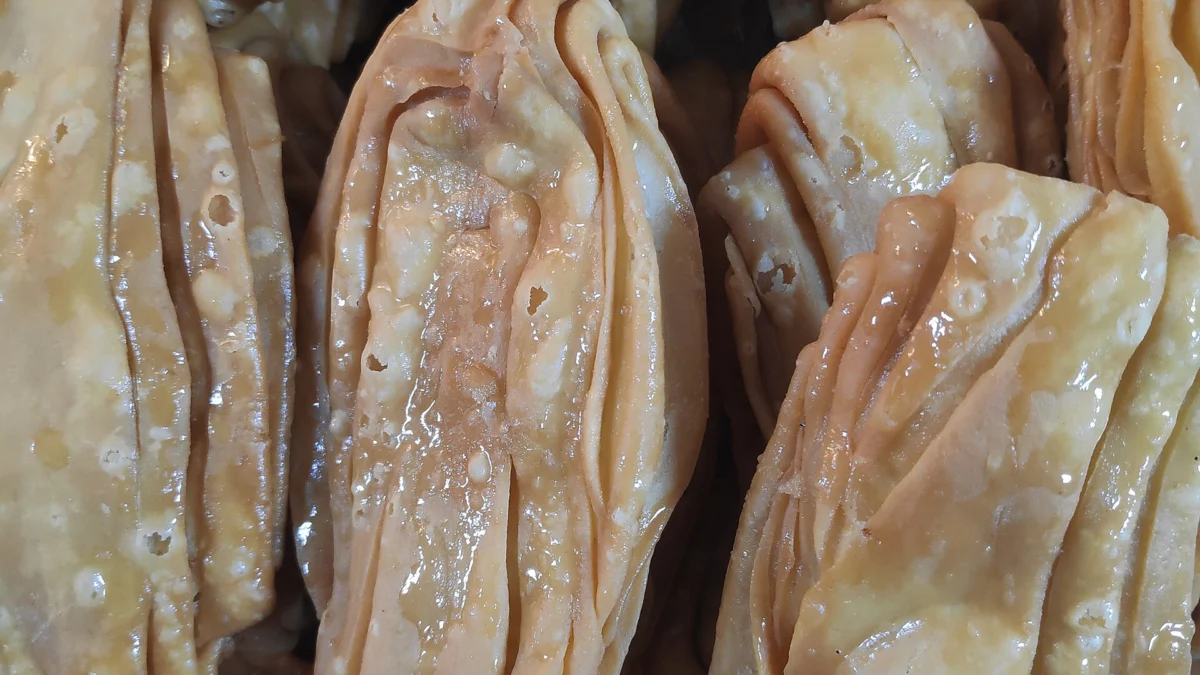
Silao is a small town on the road between Rajgir and Nalanda, about 25 km from Biharsharif and 8 km from Rajgir, according to the Government of Bihar. It would be easy to drive straight through it, if not for the long row of sweet shops, their glass cases stacked with golden, flaky rectangles. This is khaja country. Silao’s khaja is one of Bihar’s few foods with a Geographical Indication tag, and for the people of Nalanda district it is a matter of real pride.
A sweet of many layers
Khaja is a pastry built from thin sheets of dough. India’s tourism ministry describes Silao khaja as made from 12 to 16 very thin sheets stacked one on top of another, using wheat flour, maida, sugar, ghee, cardamom and aniseed. The layered dough is fried in ghee until it puffs and separates into crisp leaves, then coated with or dipped in sugar syrup. The result is light and shattering, often compared to baklava, and much less sweet than it looks.
Silao’s khaja-makers say the quality also depends on things that cannot be copied: the town’s climate and its water, a local belief that the tourism ministry notes. Whatever the reason, Silao khaja is distinct enough that Bihar applied for, and won, a GI tag to protect its name.
The GI tag
Silao Ka Khaja was registered as a Geographical Indication in the “food stuffs” category in 2018, according to Bihar Bhawan’s list of the state’s GI products, alongside agricultural products such as Katarni rice, Magahi paan, Shahi litchi and Bhagalpuri Zardalu mango. A GI tag recognises that a product’s qualities are linked to a particular place, and it helps protect producers from imitation. You can read more about Silao’s history and varieties in our earlier story, Silao Khaja: The Layered Sweet of Nalanda.
Tradition and folklore
Khaja is believed to have originated in the region of ancient Magadha, and Silao lies close to some of the most important Buddhist sites in India. A popular local belief, noted by India’s tourism ministry, holds that the Buddha was served khaja by the people of Silao as he travelled from Rajgir to Nalanda. There is no historical record of this, and it should be read as a much-loved folk tale. What is real is the town’s long tradition of khaja-making, which the Government of Bihar describes as ancient.
The shapes of khaja
Walk into a Silao shop and you will find several kinds. The Government of Bihar lists chandshahi, round, palvidar and Gandhi topa varieties, and notes that the rectangular khaja is the most popular. Shops sell both sweet and plain (namkeen) versions, and fresh khaja is packed in boxes for travellers.
Khaja beyond Silao
Silao is the most famous home of khaja, but not the only one. Wikipedia’s survey of Bihari cuisine also names Pipra in Supaul district as known for its khaja, and the travel magazine Outlook Traveller notes that Patna’s own khaja, sold in shops on Ashok Rajpath and elsewhere, is known for its cube-like shape and is especially popular during Chhath. Outside Bihar, khaja is a famous offering at the Jagannath temple in Puri, and Andhra Pradesh has its own kaja.
Khaja in Bihari life
Khaja is part of the region’s rituals and celebrations. It is among the foods offered at Chhath in many families, and in the Magadh region it is traditionally given as a gift at a daughter’s wedding. Visitors to Rajgir and Nalanda buy it as a souvenir, and families send it to relatives in other cities.
From Silao to the world
In recent years Silao khaja has begun to reach far beyond Bihar. In May 2025, Patna Press reported that the Government of India had permitted the export of GI-tagged Silao khaja through India Post, announced at an international buyer-seller conference on GI-tagged Bihari food in Patna, with buyers from Australia, Dubai, Canada, Singapore, London, the United States, Russia and Africa showing interest. Before this, exports had been limited to individual online orders. A leading Silao manufacturer told the paper that only khaja made with pure ghee would be exported.
How to enjoy it
Khaja is best eaten fresh, when the layers are at their crispest. In Silao, you can watch it being fried in large woks and stacked while still warm. It keeps for some days in an airtight box, which makes it ideal for carrying home. Many people eat it with tea, and some prefer the less sweet varieties.
Why it matters
Silao khaja shows how a small town can sustain a craft for generations and turn it into a recognised regional product. It supports families of halwais (sweet-makers) and shopkeepers, draws visitors on the Rajgir–Nalanda route and gives Nalanda district a taste to be known by, alongside its ancient university.
Conclusion
Silao khaja is the sweet pride of Nalanda: delicate, many-layered and rooted in place. If you are travelling to Nalanda or Rajgir, stop at Silao and buy a box fresh from the wok. For more of Bihar’s sweets, read about Gaya tilkut and anarsa.