Thekua: The Sweet That Defines Chhath
Wheat flour, jaggery and ghee pressed into wooden moulds and fried slowly before dawn. Inside the kitchens where Chhath’s thekua is made.
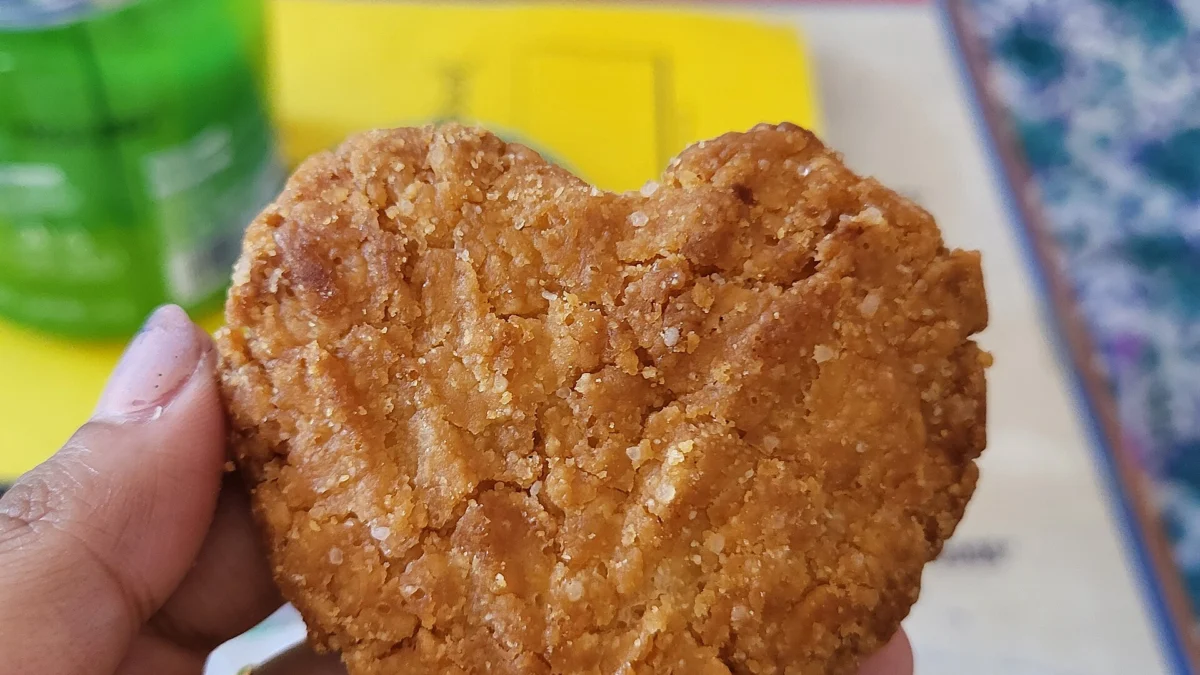
In the days before Chhath, the kitchens of Bihar change. Floors are scrubbed, utensils are set aside for the festival, and the air fills with the smell of wheat flour, jaggery and ghee. Late into the night, women shape dough into small discs, press them into carved wooden moulds and slide them into hot ghee. By morning there are baskets of thekua, crisp, golden and patterned, ready to be carried to the river. For millions of Biharis, this is the sweet that defines their biggest festival.
The sweet at the heart of the offering
Thekua is a hard, crunchy sweet made from whole-wheat flour, jaggery or sugar and ghee. Wikipedia’s survey of Bihari cuisine describes the Chhath sweet as made of ghee, jaggery and whole-meal flour, flavoured with aniseed. India’s tourism ministry calls it revered as a prasad during Bihar’s Chhath Puja, and notes that it is also a popular breakfast sweet. Thekua goes by several local names, including khajuria, thokni and tikari, and it is made across Bihar, Jharkhand, eastern Uttar Pradesh and the Nepal Terai.
When thekua is made
Chhath lasts four days. According to Wikipedia’s account of Bhojpuri cuisine, on the third day, known in the Bhojpuri region as Dala Chhath, the women who are fasting prepare thekua along with kasar (a sweet of coarsely ground rice), belgrami and puri. These are arranged with fruit and sugarcane in bamboo baskets and soop and offered to the setting sun that evening and the rising sun the next morning. After the final offering, thekua is distributed as prasad to family, neighbours and everyone who comes to the ghat.
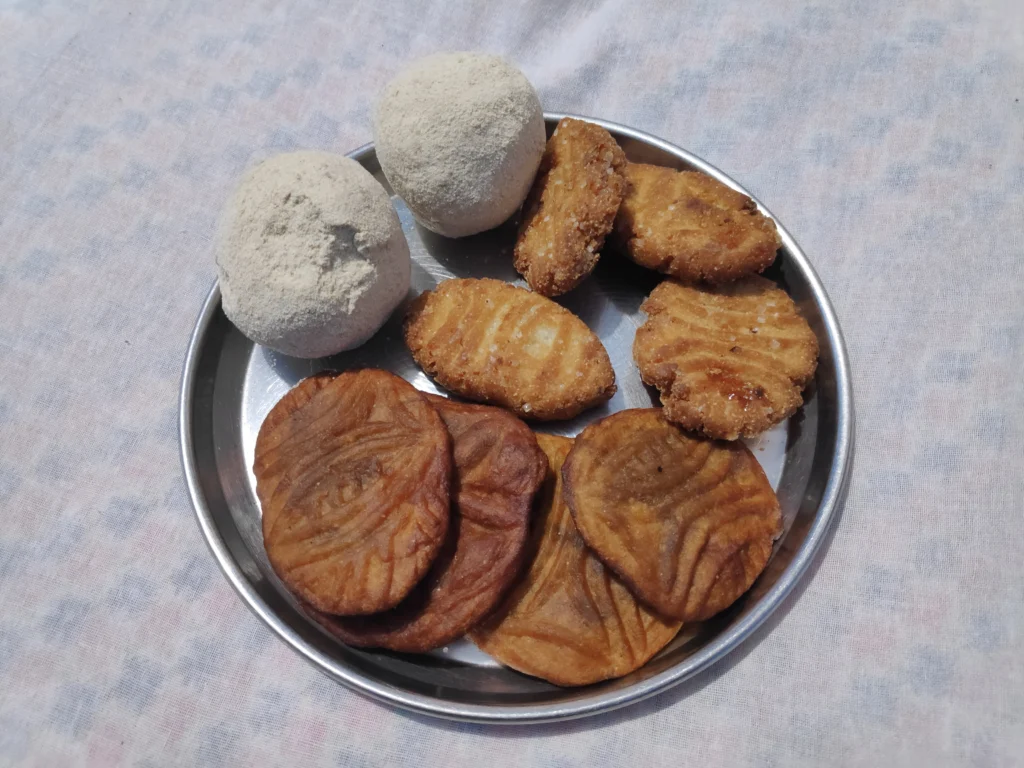
Purity in the kitchen
Because thekua is an offering, its preparation follows rules of purity. The food for Chhath is strictly vegetarian and cooked without onion, garlic or salt. Thekua for the festival is often made in the room used for worship, or in a kitchen cleaned specially for the purpose, using fresh ingredients and separate utensils. In many families the women keeping the fast make it themselves, while other relatives help with shaping and frying. Making thekua is therefore not just cooking; it is part of the vrat.
How thekua is made
Every family has its own recipe, but the basic method is the same:
- Jaggery is melted with a little water, or sugar syrup is prepared, and cooled until warm.
- Whole-wheat flour is rubbed with ghee until it feels like breadcrumbs, then mixed with the jaggery syrup and flavourings such as aniseed or fennel, cardamom, grated dry coconut or chopped nuts.
- The stiff dough is divided into small balls, which are pressed flat into carved wooden moulds or shaped by hand and marked with a fork.
- The discs are fried slowly in ghee or oil until reddish-brown, and left to cool, when they harden.
Slow frying is the secret: thekua cooked too quickly can stay raw inside. Properly made, thekua keeps for days without any preservatives, which is why it travels so well.
The art of the mould
The patterns on thekua come from wooden moulds carved with flowers, leaves, circles and geometric designs. They are sold in markets before Chhath, alongside bamboo baskets and clay lamps, and many families keep theirs for years. Where there is no mould, women use the back of a fork, the edge of a spoon or simply their fingers to make a pattern. A tray of patterned thekua is a small piece of folk art in its own right.
Thekua beyond Chhath
Thekua is not only festival food. Because it keeps well, it is a favourite snack with tea and a common gift for travellers. In Nepal and parts of Bihar it is a traditional koseli, the gift of food a guest brings on a visit. Students leaving for distant cities often carry a tin of thekua from home, and families send boxes to relatives who cannot come back for Chhath.
Regional variations
Some families make thekua with jaggery, giving it a dark colour and caramel taste; others use sugar for a lighter sweet. Some add coconut, sesame, fennel, cardamom or dry fruit, and some use semolina or milk for a softer bite. In parts of Jharkhand and Nepal, related sweets are made for other festivals and family occasions under different names.
A record and a reminder
Thekua’s place in Bihar’s affections is easy to see. In 2019, a group of 16 people in Darbhanga made a thekua weighing 91 kg in an attempt to enter the Limca Book of Records. Most thekua, of course, are made at a far humbler scale, by families who have made them the same way for generations.
Modern popularity
Thekua is now sold year-round by sweet shops in Bihar and by online sellers who ship across India and abroad, and health-minded versions made with millets or less sugar have appeared. For Chhath itself, however, most families still insist on making their own. Read our earlier story, Thekua: the sweet of Chhath and its place in Bihar, for more on its history.
Conclusion
Thekua is made from the simplest of ingredients, but it carries the meaning of Chhath: devotion, discipline, family and sharing. To taste a thekua fresh from the ghat, given as prasad by a stranger who has fasted for days, is to taste Bihar at its most generous. For more of Bihar’s sweets, read about malpua and Gaya tilkut.