Malpua, Anarsa and Tilkut: Bihar’s Traditional Sweets
Holi malpua, sesame-crusted anarsa and Gaya’s winter tilkut. The history, making and festivals behind three of Bihar’s best-loved sweets.
Every season in Bihar has its sweet. In winter, the streets of Gaya smell of sesame and jaggery as tilkut is pounded by hand. At Holi, kitchens across the state fry stacks of malpua. Around Diwali and on special occasions, sesame-crusted anarsa appear in sweet shops and homes. These three sweets, very different in taste and texture, are among the most loved in Bihar, and each carries its own history and associations.
Tilkut: the winter sweet of Gaya
Tilkut is a dry sweet made by pounding til (sesame seeds) with jaggery or sugar. It is made and eaten above all around Makar Sankranti, known in Bihar as Sakraat, in mid-January, when sesame and jaggery are eaten across north India. In the Bhojpuri region it is also prepared for the Ganesh Puja held on Magh Chaturthi.
The best tilkut is said to come from Gaya, where it is produced in large quantities every winter. One account traces its commercial production to the estate of Tekari near Gaya, about 150 years ago, whose ruler is said to have been fond of the sweet and to have encouraged its makers. A sweet called palala, mentioned in Buddhist literature, is thought by some to refer to a similar preparation of sesame. Both of these claims are traditions rather than firmly documented history.
Three main kinds of tilkut are sold: white tilkut made with refined sugar, light brown tilkut made with unrefined sugar (shakkar) and dark brown tilkut made with jaggery. Round, flat tilkut is the most common form, while small nut-sized pieces are called tillouri. Because winter is when sugarcane is harvested and jaggery is fresh, it is also the main season for tilkut, though demand is now strong enough that it is made in smaller quantities through the year. Read more in our entry on tilkut.
Anarsa: rice, jaggery and poppy seeds
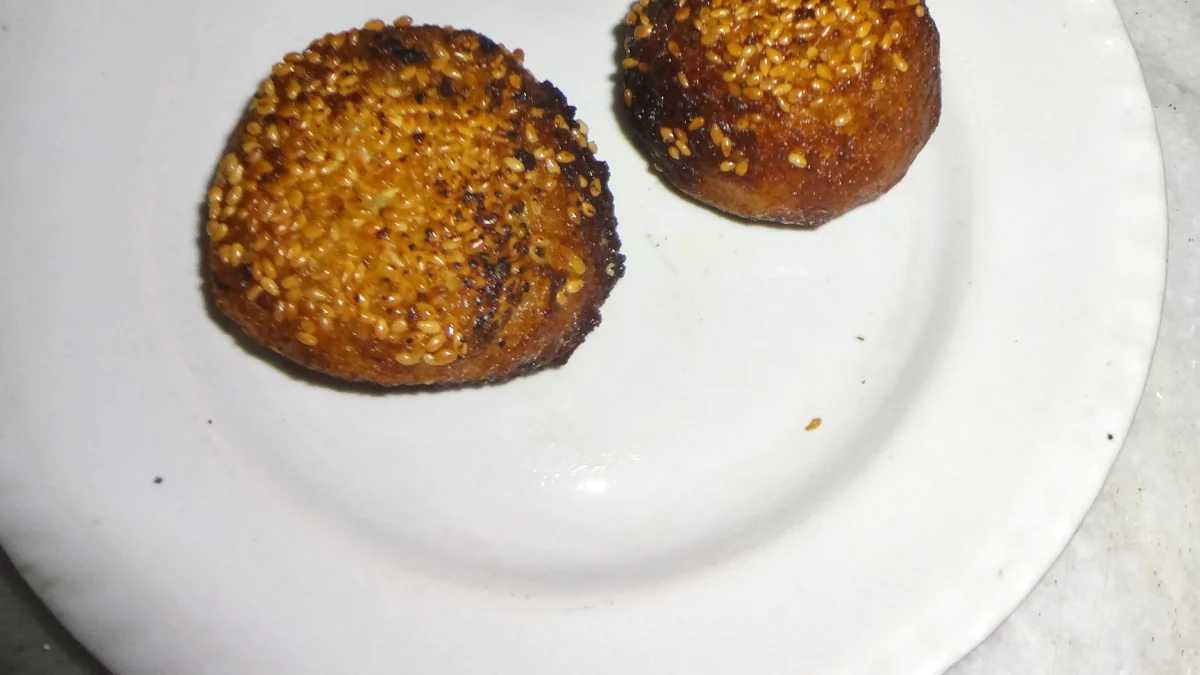
Anarsa is a rice-based sweet popular in Bihar, especially in Gaya, as well as in Nepal and Maharashtra. Its main ingredients are rice, jaggery, poppy or sesame seeds and ghee. It is associated with Diwali and other special occasions.
Making anarsa takes patience. Rice is soaked in water for several days, with the water changed often, then dried and ground into a fine flour. The flour is mixed with jaggery to form a dough, which is shaped and rolled in poppy or sesame seeds and then fried in ghee. The Bihari version tends to be rounder and more ball-shaped than the flatter anarsa of Maharashtra, and a variation adds banana to the rice flour.
The name is often explained as coming from the Sanskrit anarasha, which some accounts interpret as meaning without corruption or decay, a fitting name for a sweet that keeps for a long time.
Malpua: the festive pancake
Malpua is a sweet, fried pancake made across the Indian subcontinent, from Odisha and Bengal to Bihar, Uttar Pradesh, Maharashtra and Nepal. It has a very long history. A sweet cake of barley flour fried in ghee or boiled and dipped in honey is described as part of the food of the Vedic period, and malpua is often said to preserve both the name and the essentials of that preparation.
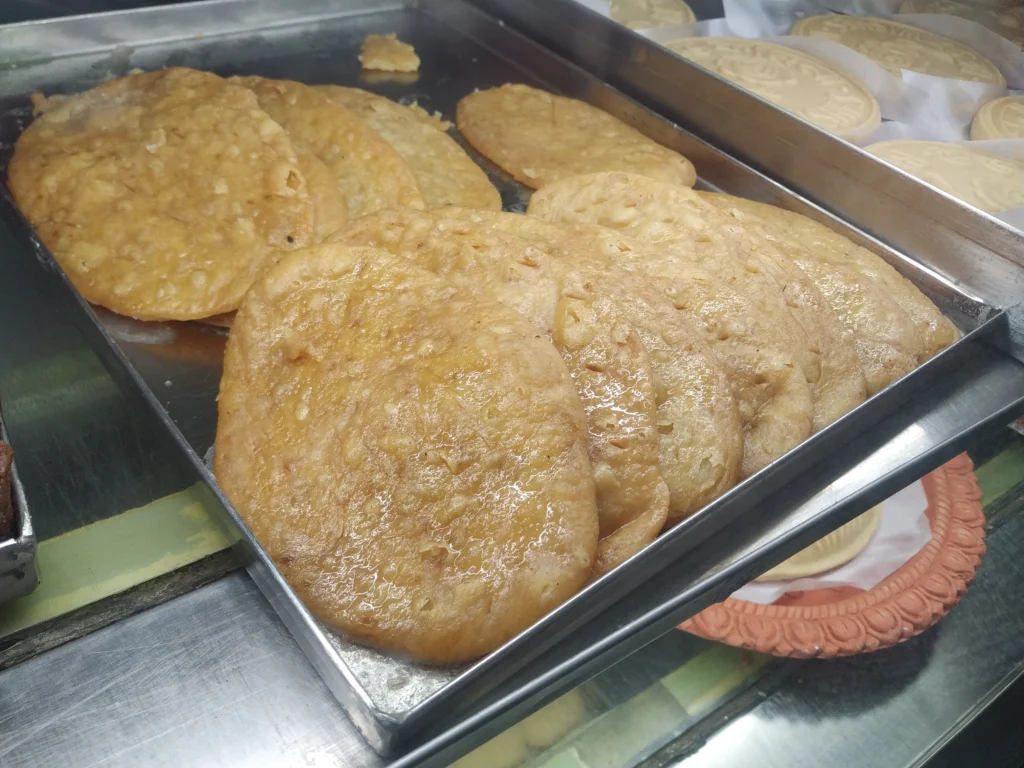
In Bihar, malpua is above all a sweet of Holi. Recipes vary from household to household. The Government of Bihar describes a version made from maida, milk, banana, coconut, cashews, raisins, sugar and cardamom, fried in ghee. Many households make it more simply, without fruit, from a batter of flour, semolina, milk or yogurt that is left to rest before being spooned into hot oil and fried until crisp at the edges. In Bihar, sugar is often added to the batter before frying, while in other regions the fried pancakes are soaked in syrup. In Bhojpuri, Maithili and Bengali households malpua may also be made from thickened milk with a little flour. In non-vegetarian homes in the Bhojpuri region, malpua is traditionally served with mutton curry at Holi, a combination that surprises many visitors.
People and places
These sweets are made both at home and by professional halwais (sweet-makers). Gaya is the most famous centre for tilkut and anarsa, and in winter its tilkut makers work through the night. Malpua is made in homes throughout the state, especially for Holi. The sweets also travel with Bihari families wherever they live, and parcels of Gaya tilkut are a common gift sent to relatives far from home.
Significance
Bihar’s traditional sweets are closely tied to the agricultural year and the festival calendar. Tilkut uses the sesame and fresh jaggery of winter. Anarsa uses rice, the staple grain. Malpua marks the spring festival of colours. Like thekua, the sweet of Chhath, and khaja from Silao, these sweets are part of how Bihar celebrates and remembers.
Regional variations
All three sweets exist in other parts of India, with local differences. Tilkut is known as gajak, tilpatti and by other names elsewhere, and is also made in Jharkhand, eastern Uttar Pradesh and West Bengal. Anarsa in Maharashtra is flatter than in Bihar. Malpua varies the most: Odisha’s version is soaked in syrup, Bengal’s may be made with coconut or milk, and in Nepal’s Kathmandu Valley a version called marpa is made with banana and fennel. Malpua is also prepared by Muslim families across India during Ramadan, often with khoya.
Facts worth knowing
- Gaya is the most famous centre of tilkut-making in Bihar.
- Tilkut comes in three main types, made with white sugar, unrefined sugar or jaggery.
- Anarsa rice is soaked for several days before it is ground.
- In the Bhojpuri region, malpua is sometimes eaten with mutton curry at Holi.
How these sweets have changed
Traditional sweets were once made mainly at home, by women who knew the techniques by heart. Today more families buy them from shops, and sweet-makers in Gaya and Patna sell boxed tilkut and anarsa across India and online. New versions have appeared too, such as tilkut made with sugar-free sweeteners or flavoured with chocolate. Even so, many families still make malpua at home for Holi, and buying fresh tilkut in winter remains a ritual for many.
Bihar’s sweets today
If you visit Gaya in December or January, follow the sound of wooden mallets to the tilkut workshops, where the sweet is pounded by hand. In Patna and other cities, sweet shops sell anarsa, khaja and seasonal specialities side by side. And if you are in Bihar at Holi, you will almost certainly be offered malpua.
Conclusion
Malpua, anarsa and tilkut show how deeply sweets are tied to the seasons and festivals of Bihar. Each is simple in its ingredients, rice, wheat, sesame, jaggery, milk, but rich in tradition. For more of Bihar’s food, read about sattu and dal pitha.