The Folk Songs of Bihar: Music That Lives in Every Occasion
Sohar for a birth, kajari for the rains, Chhath geet at dawn. A guide to the folk songs of Bihar, the poets behind them and how they have changed.
In Bihar, there is a song for almost everything. A child is born, and the women of the house sing sohar. Paddy is transplanted in the monsoon rain, and the fields fill with ropni songs. A daughter leaves for her husband’s home, and everyone in the courtyard is in tears at the songs of farewell. At Chhath, the ghats ring with hymns to the sun. Folk song in Bihar is not a performance for an audience so much as a part of life itself, sung by ordinary people, mostly women, to mark the moments that matter.
A tradition carried by voice
Bihar’s folk songs have been passed down orally for centuries, learned by listening and singing rather than from books. They are sung in the state’s many languages, including Bhojpuri, Maithili, Magahi, Angika and Bajjika, and they vary from region to region and even from village to village.
Some of the earliest written records of these songs come from the colonial period. George Abraham Grierson, the British linguist who later directed the Linguistic Survey of India, collected and published Bihari folk songs in the 1880s while serving as an official in the province. Since then, folklorists, writers and, more recently, recording artists have documented thousands of songs.
Songs for every stage of life
As Wikipedia’s survey of the music of Bihar puts it, the region’s folk songs are associated with the various events in the life of an ordinary person. Among the best-known types are:
- Sohar, songs of childbirth, sung by women to celebrate the birth of a child, especially in the days after the birth.
- Wedding songs, a large family of songs sung at each stage of a marriage, from the first rituals to the bride’s departure. In Mithila the songs of a daughter’s farewell are called samdaun. Read more in our story on the wedding songs of Bihar.
- Work songs, such as ropni geet, sung while transplanting paddy, and katni geet, sung at harvest.
- Devotional songs, including the Chhath geet sung through the four days of Chhath, harkirtan and the round-the-clock chanting known as ashtajam.
- Ballads, including songs about Kunwar Singh, the leader of the 1857 uprising from Jagdishpur in Bhojpur, whose deeds are remembered in folk song across the plains of Bihar.
Songs of the seasons
Many of Bihar’s folk songs belong to a particular season. Their mood and themes follow the year.
Kajari is sung during the monsoon, from late June to September. It comes from the Bhojpuri region of Uttar Pradesh and western Bihar, and its songs dwell on the longing of women separated from their husbands, who are often far away, with crows and clouds asked to carry messages to the absent beloved. Poets from Bihar who composed kajari include Bhikhari Thakur and Mahendar Misir of Saran and the saint-poet Lachhimi Sakhi of Gopalganj.
Chaiti is sung in the spring month of Chait (March and April), around Ram Navami. It originated in the Bhojpuri region and celebrates spring, often invoking Ram. Over time it was taken up by classical musicians and became a semi-classical form, sung by artists such as Girija Devi.
Phagua, or hori, belongs to the season of Holi, and is sung in groups with dholak and jhal (cymbals), often with great energy.
Important people and places
Bihar’s folk song tradition has been shaped by many poets and singers. Among the most important are:
- Vidyapati (c. 1352–1448), the great Maithili poet of the court of Mithila, wrote hundreds of songs of the love of Radha and Krishna and devotional songs to Shiva and other deities. His songs are still sung in Mithila today, at weddings, festivals and in daily worship.
- Bhikhari Thakur (1887–1971), from Kutubpur in Saran, the playwright and poet often called the Shakespeare of Bhojpuri, whose songs and plays, including Bidesia, spoke of migration, separation and social injustice.
- Mahendar Misir, a Bhojpuri poet and singer from Saran known for his purbi and kajari songs.
- Sharda Sinha (1952–2024), from Supaul, whose recordings of wedding songs and Chhath songs became part of family celebrations across Bihar and among people of Bihari origin everywhere.
Folk music in Bihar was also carried by professional and semi-professional performers, such as the Kathaks who travelled in groups with dholak, sarangi and majira, and groups known as Pamaria, Bhakliya, Kirtaniya and Bhajaniya.
Significance
Folk songs carry a great deal of Bihar’s social history. In wedding songs and work songs, women voice joy, teasing, complaint and grief that they could rarely express in other ways. In the migration songs of the Bhojpuri region, the pain of families separated by poverty is recorded generation after generation. The songs also carry knowledge: of rituals, of the farming year and of the stories of the gods.
When people from Bihar were taken as indentured labourers in the 19th century to Mauritius, the Caribbean, South Africa and Fiji, they took their songs with them. Bhojpuri folk songs are still sung in those countries, and they have influenced local music there.
Regional variations
Each region of Bihar has its own repertoire. Mithila is especially rich in songs for rituals and for the life cycle, along with songs in the tradition of Vidyapati. The Bhojpuri region of western Bihar is famous for its seasonal songs, kajari, chaiti and phagua, and for songs of migration. Magadh and Anga have their own forms, and Adivasi communities in the south and east of the state have their own songs and dances, such as jhumar. Dance and song often go together, as in Jhijhiya and Jat-Jatin.
Facts worth knowing
- Vidyapati is said to have written some five hundred love songs, mainly between 1380 and 1406.
- Kajari takes its name from kajar, the kohl used to line the eyes.
- Chaiti songs are usually set in spring ragas such as Khamaj, Bhairavi, Kafi and Pilu.
- Sharda Sinha received the Padma Vibhushan posthumously in 2025.
How the tradition has changed
Recording technology transformed Bihari folk song. Cassettes, then CDs and now online platforms spread songs far beyond their villages, turned singers such as Sharda Sinha into household names and made folk tunes the basis of a huge popular music industry in Bhojpuri. That industry has brought new audiences, and also criticism for songs that some listeners find vulgar or far removed from tradition.
In villages, fewer young people learn the old songs by heart, as recorded music takes over at weddings and festivals. At the same time, a new generation of singers has built large online followings by performing traditional songs.
Folk songs in modern Bihar
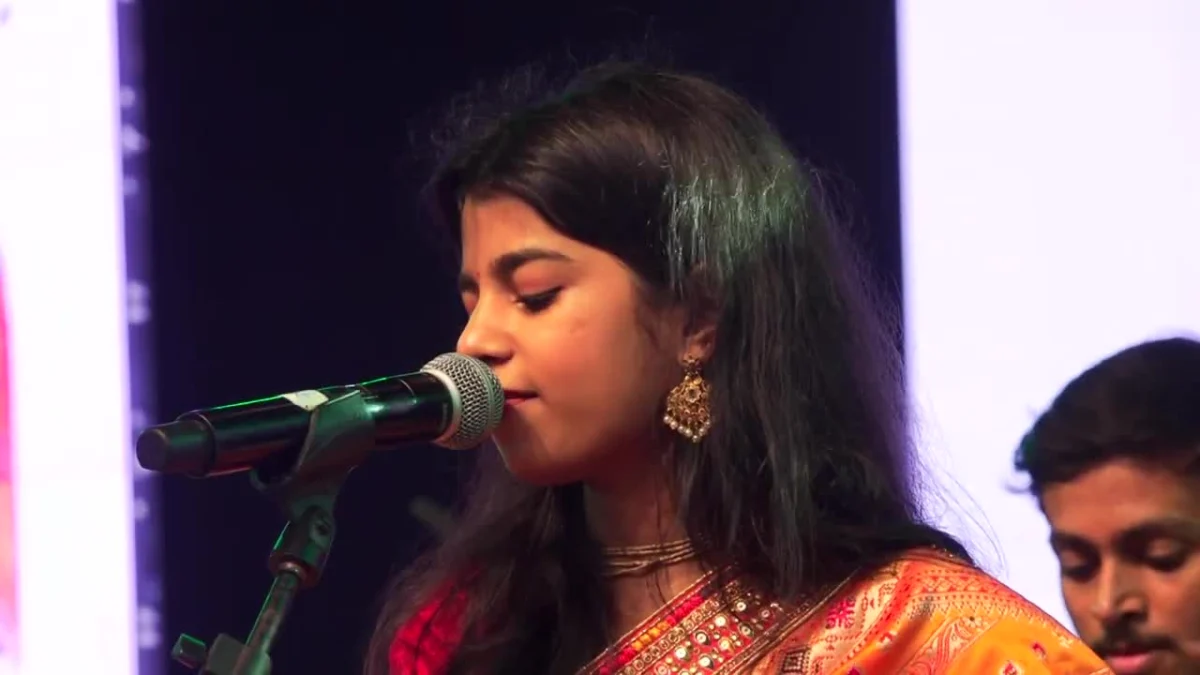
Today, it is still impossible to imagine Chhath without its songs, or a wedding without women singing in the courtyard. Folk songs are performed at state cultural festivals, taught in some schools and cultural institutions, and shared on social media by singers from Bihar, such as Maithili Thakur, pictured at the top of this page.
Conclusion
The folk songs of Bihar are the soundtrack of its people’s lives. They mark birth, marriage, farewell, labour, prayer and the turning of the seasons, and they carry the voices of generations of women and men who never wrote a word down. The best way to understand them is to listen, at a Chhath ghat at dawn, or in a courtyard on the night of a wedding.