Jhijhiya: The Folk Dance of North Bihar
Lit clay pots, circling women and songs to the goddess. How Mithila’s Jhijhiya is danced through the ten nights of Navratri.
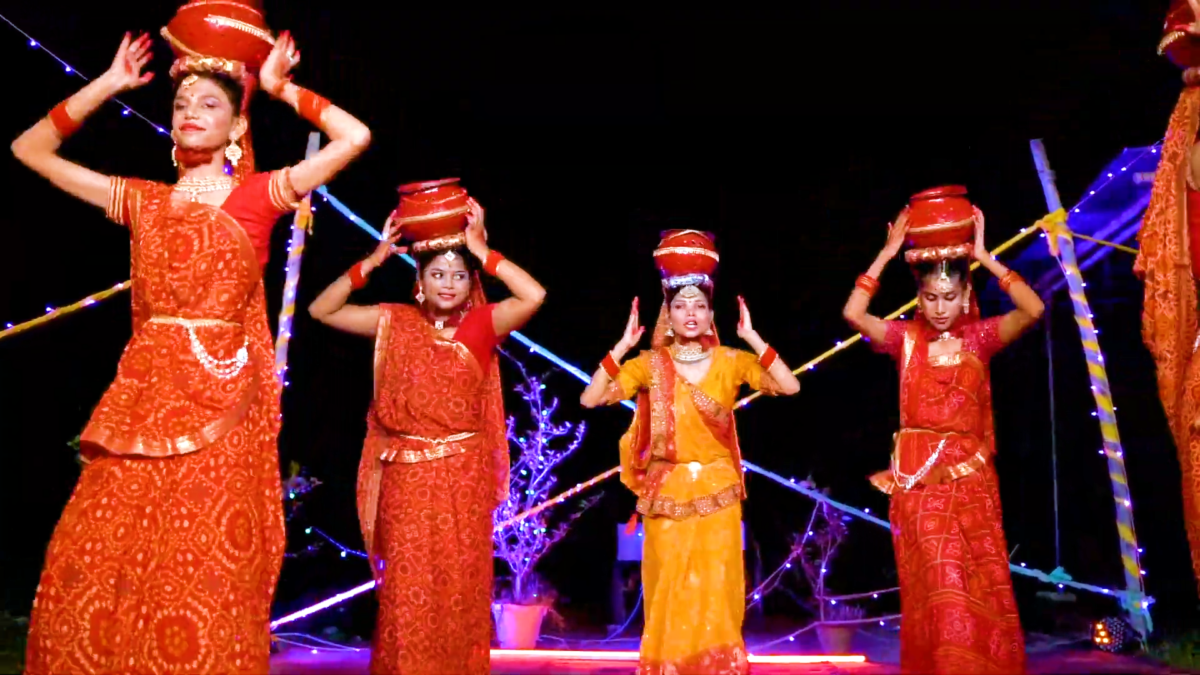
During the ten nights of Navratri, in the villages of Mithila, you may see small points of light moving in a circle in the dark. Come closer and they turn out to be clay pots, pierced with dozens of holes and lit from within by an oil lamp, balanced on the heads of women who are dancing and singing together. This is Jhijhiya, a ritual folk dance of north Bihar and the Nepal Terai, performed in honour of the goddess and for the protection of children and families.
When and why Jhijhiya is performed
Jhijhiya is danced during Dussehra, in the Hindu month of Ashvin (September or October). It is performed every evening for ten days, from Ghatasthapana, the installation of the sacred pot that begins Navratri, until Vijayadashami. It is dedicated to the goddess Durga, worshipped in the form of Bhairavi, and it has a clear protective purpose. The dance is believed to keep children, families and the whole village safe from witchcraft and the evil eye.
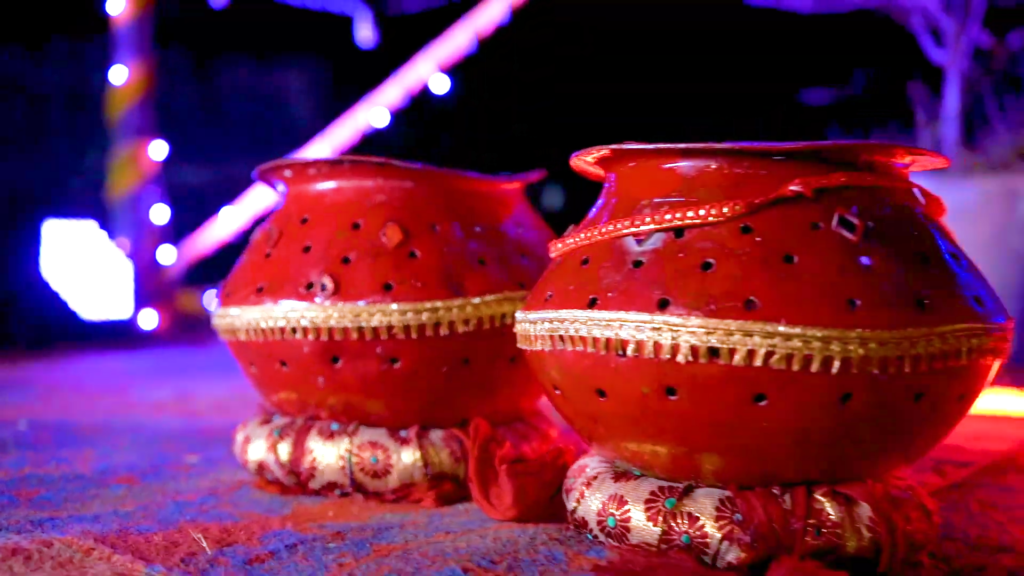
Belief and folklore are central to the dance. A widely held belief is that if a witch manages to count all the holes in the pot on a dancer’s head, the dancer will die. The holes are therefore many, and the dance is kept moving so that no one can count them.
The origin story
Since Jhijhiya has been passed down orally, there is no documented account of its origins. A legend is told to explain it. In this story, a king called Chitrasen, who had no children, named his nephew Balruchi as his heir. The young queen, skilled in dark magic, fell in love with Balruchi, and when he rejected her, she feigned illness and demanded his blood as a cure. The soldiers sent to kill him let him go and brought back a deer’s blood instead.
In the forest, Balruchi was adopted by an old woman who turned out to be a powerful witch. Years later, the king recognised his nephew when Balruchi finished a song only the two of them knew. When Balruchi agreed to return to the palace, the old witch attacked him with spells, and the queen, now repentant, used her own powers to fight and defeat her. Afterwards, the queen ordered that protective rituals be performed every year for Balruchi, and ordinary people, so the story goes, adopted the ritual to protect their own children. This is a folk legend, and it should be read as a story that explains the dance, not as history.
How Jhijhiya is danced
Jhijhiya is performed by women and girls in groups, often of five to fifteen. Each dancer balances a perforated clay pot, sometimes called a jhijhari, on her head, with a lit lamp inside. The dancers move round and round in a circle in a fixed place while they sing, to the accompaniment of the dhol and manjira.
There are two main kinds of Jhijhiya songs. One praises the goddess. The other asks for protection against witches and dark magic. Many songs are addressed to village folk deities, such as Brahma Baba, in the form of a conversation, asking them to come and guard the dancers and their children.
Jhijhiya is also a community event. After the dance formally begins, with a performance at a sacred site on the first day, the dancers go from house to house to perform. At each home they ask for grain and food, and on Vijayadashami, after the final prayers, what they have collected is used for a shared feast.
People and places
Jhijhiya is a dance of the Mithila region, performed in districts such as Madhubani, Darbhanga, Sitamarhi and Samastipur, and across the border in the Madhesh region of Nepal. Some accounts associate it particularly with the women of the Musahar community, one of Bihar’s most marginalised groups, though it is performed by women across the region. The songs are in Maithili.
Significance
Jhijhiya shows how folk religion in Mithila has its own rituals alongside temple worship. It brings women together as performers and as protectors of their families, gives them a public role in the festival and preserves a repertoire of songs and beliefs that might otherwise have been lost. It also reflects the importance of the mother goddess in the villages of eastern India, and the fears, of illness, misfortune and the evil eye, that rural families have long sought protection from.
Regional variations
The basic form of Jhijhiya, women dancing with lit pots on their heads, is shared across Mithila, but songs, deities invoked and customs vary from village to village. Its influence has also spread to other parts of north Bihar and to Bhojpuri-speaking areas. In Nepal, Jhijhiya has become a familiar symbol of Mithila culture and is performed at cultural festivals in Kathmandu as well as in the Terai.
Facts worth knowing
- Jhijhiya is performed for ten evenings, from Ghatasthapana to Vijayadashami.
- The dancers’ clay pots are pierced with many holes and lit from inside with a lamp.
- According to belief, a witch who counts the holes in a dancer’s pot could cause her death.
- The grain collected during house-to-house performances pays for a feast on Vijayadashami.
How the dance has changed
In many villages, Jhijhiya is still performed as a ritual, but it has also become a stage dance. Cultural troupes present it at festivals, state events and on television, often with matching costumes and choreography. It has been showcased at national cultural events in India and at folk festivals in Nepal. This growing visibility has given some women performers new recognition and income, while the ritual beliefs that once surrounded the dance are less emphasised on stage.
Across the border in Nepal, the Kathmandu Post reported in 2019 that Jhijhiya had come close to disappearing around Janakpur, where it was kept up mainly by the Musahar community, a Dalit group. A cultural conservation programme led by Dev Narayan Mandal of the Mithila Wildlife Trust trained Musahar women and men in the dance, and the troupe began to perform at festivals and in towns of Dhanusha district, earning an income and, as the performers told the newspaper, greater confidence and a stronger voice in their community. The report also described a stage form in which the pots are set in a bamboo frame called the panchamukhi jhijhiya, with men playing the dhol and other instruments.
Jhijhiya in modern Bihar
Today, Jhijhiya is one of the most recognisable images of Mithila’s folk culture, featured in cultural programmes and in photographs of Bihar’s festivals. In the villages, it remains part of Navratri, with groups of girls learning the songs from their mothers and grandmothers.
Conclusion
Jhijhiya is a dance of light, devotion and protection. The glowing clay pots, the circling women and their songs to the goddess and village deities make it one of the most beautiful sights of a Mithila Navratri. For more of the region’s traditions, read about Jat-Jatin, Sama-Chakeva and the folk songs of Bihar.