Jat-Jatin: The Traditional Folk Dance of Bihar
A couple’s love, quarrels and separation, danced by women on monsoon nights. The story, ritual and performance of Mithila’s Jat-Jatin.
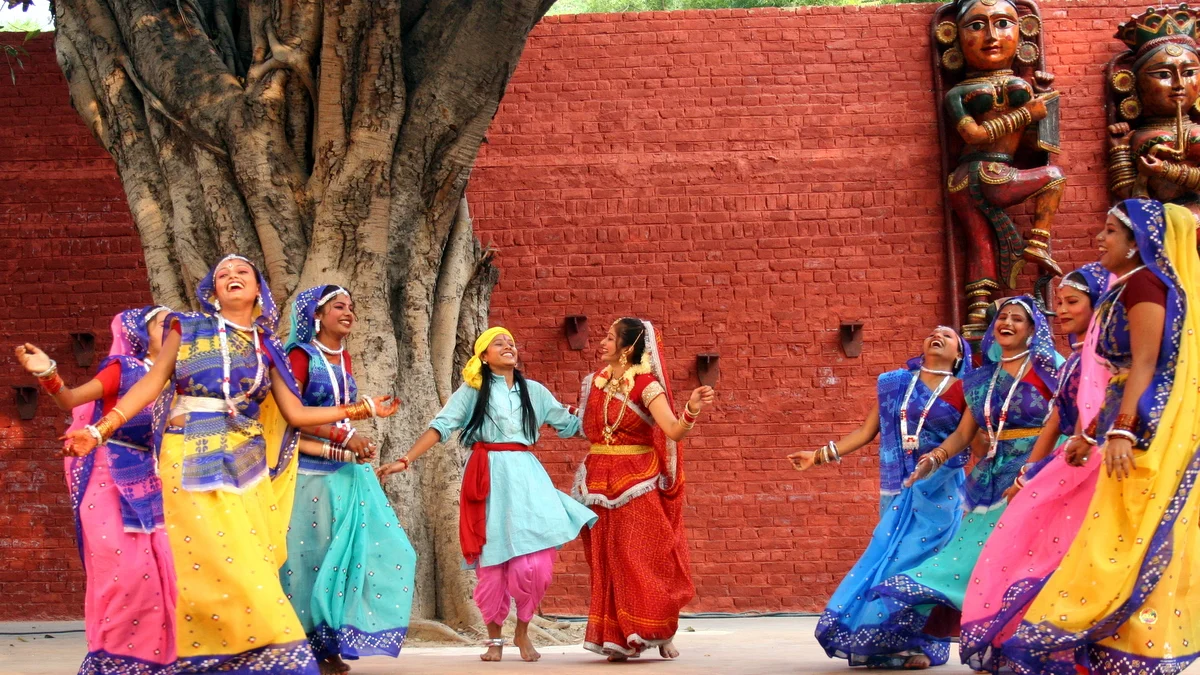
On monsoon nights in Mithila, when the moon is out and the fields are waiting for rain, groups of women once gathered in the open to dance until dawn. They sang the story of two lovers, Jata and Jatin, acting out their quarrels, their separation and their reunion, to the beat of a drum. This is Jat-Jatin, one of the best-known folk dances of north Bihar and the Terai of Nepal, and a rare example of a dance that is at once a love story, a social comment and a prayer for rain.
The story of Jata and Jatin
Jat-Jatin takes its name from its two characters, a husband and wife called Jata (or Jat) and Jatin. Their story is a folk narrative rather than a historical one, and it is told in many versions. The Eastern Zonal Cultural Centre, a body under India’s Ministry of Culture, describes the dance as enacting the love story of Jata and Jatin, in which, at the climax, a wicked boatman kidnaps Jatin and separates the lovers, who are eventually reunited.
Other versions focus on everyday life: the couple’s arguments, the wife’s demands and the husband’s excuses, and above all the pain of separation when the husband leaves home to find work. In this telling, which is often staged as a duet, the man prepares to depart while the woman circles him, her dupatta fluttering in a gesture of grief. The songs are plaintive, but they also carry a sense of resilience and humour, as the couple’s troubles are drawn from the hardships that rural families in Mithila knew well: poverty, drought and the need to migrate.
A dance for rain
Jat-Jatin is also associated with a ritual purpose. According to accounts of the tradition, women in Mithila performed it during periods of drought, when the monsoon failed and crops were at risk, in the belief that it would please Indra, the god of rain, and bring rainfall. In this ritual form, the dance was performed at night, with Jat-Jatin songs and worship. This link between women’s songs, the monsoon and the fertility of the land is found in many folk traditions of eastern India.
How Jat-Jatin is performed
In its traditional form, as described by the Eastern Zonal Cultural Centre, Jat-Jatin is danced by women of Mithilanchal on moonlit nights during the monsoon. Unmarried girls and young married women dance together to the beat of a drum, from around midnight until dawn. Because the dancers were traditionally all women, women also played the role of Jata, the husband.
The dance is performed in a group, with dancers moving in a circle and singers carrying the story forward through call and response. The music is simple: the dholak provides the rhythm, often with manjira (small cymbals). Footwork is expressive and circular, and much of the storytelling is done through gesture and facial expression. Dancers wear brightly coloured saris or long skirts with veils, and the stage version shown at festivals often uses colourful costumes, as in the photograph at the top of this page.
People and places
Jat-Jatin belongs to the Mithila region, which covers north Bihar, including districts such as Madhubani and Darbhanga, and the Madhesh region of Nepal. The songs are in Maithili. Like Mithila’s other women’s traditions, such as Sama-Chakeva and Jhijhiya, the dance was passed down orally by older women to younger ones.
Significance
Jat-Jatin matters for several reasons. It is one of the few folk forms in which women have taken on both female and male roles and used them to comment on marriage and family life. It records, in song and gesture, the hardships of rural Mithila, from drought to migration, in much the same way that Bidesia records the pain of separation in the Bhojpuri region. And as a rain ritual, it reflects the deep connection between the agricultural year and the cultural life of the region.
Regional variations
Jat-Jatin is performed differently in different places. In some villages it is a women-only ritual, held at night. In others, and especially on stage, it is a duet between a man and a woman, or a group performance with male musicians. The story also varies, from the kidnapping by the boatman to the departure of the husband for work. In the Nepal Terai, the dance is considered part of Mithila’s shared heritage and is performed at cultural events alongside other Maithili dances.
Facts worth knowing
- Jat-Jatin is named after its two characters, the couple Jata and Jatin.
- It was traditionally performed by women on moonlit monsoon nights, from midnight to dawn.
- In the ritual form, it was believed to help bring rain during drought.
- Its songs are in Maithili and accompanied mainly by the dholak.
How the tradition has changed
Like many folk traditions in rural Bihar, the all-night Jat-Jatin performance has become rarer, as village life has changed and entertainment has moved to screens. At the same time, the dance has found a new stage. Cultural troupes perform shortened versions at state festivals, at events organised by cultural centres and on television and online, often as a duet. These performances keep the dance visible, though they tend to emphasise its romantic and comic sides over its ritual meaning.
Jat-Jatin in modern Bihar
Today Jat-Jatin is regularly presented as one of the signature folk dances of Bihar, alongside Jhijhiya, Jhumar and others, in school programmes, cultural festivals and official events. For the women of Mithila who still remember the songs, it is also a link to a time when dancing through a monsoon night was part of village life.
Conclusion
Jat-Jatin is a small dance with a big story. It holds love and separation, humour and hardship, and a prayer for rain, all sung by women in the moonlight. To learn more about the music behind it, read our guide to the folk songs of Bihar.