Mithila Weddings: Rituals, Songs and Kohbar Traditions
From Saurath Sabha and the panji records to the painted kohbar and the songs of farewell. The rituals and meaning of a Mithila wedding.
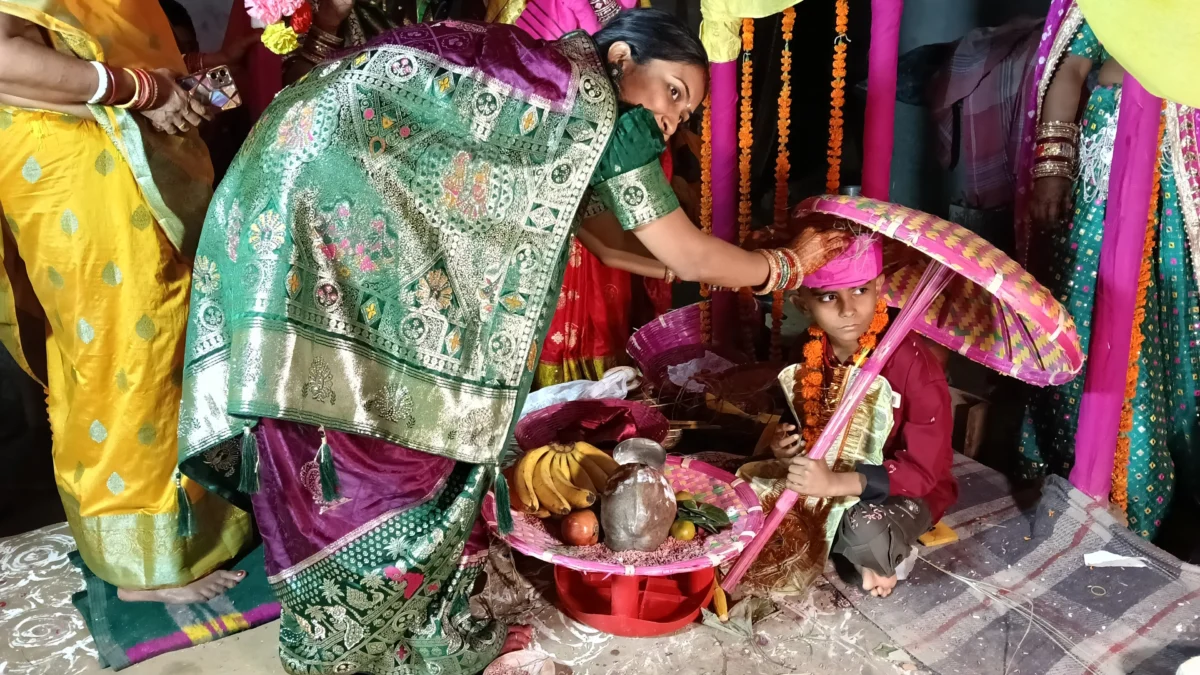
A wedding in Mithila is not a single ceremony but a season of rituals. It begins weeks before the wedding day, with negotiations, almanac readings and preparations, and it continues for days, even months, afterwards. Along the way, the women of the family paint the walls of a special room, draw sacred patterns on the floor, sing songs for every step and lead rituals that have been handed down for generations. Mithila believes that its most famous wedding was that of Sita and Ram, and something of that sense of occasion still surrounds every marriage in the region.
Origins and the memory of Sita
Mithila’s wedding customs are part of a much wider Hindu tradition, but the region gives them its own form and meaning. Local tradition holds that King Janaka had the walls of his kingdom painted to celebrate the marriage of his daughter Sita to Ram, and Mithila’s painting tradition is often traced to that story. Whatever its historical basis, the belief shows how closely art and marriage are linked in Mithila. To read more about the wedding of Sita and Ram and how it is celebrated, see our story on Vivah Panchami.
Arranging a marriage: Saurath Sabha and the panji
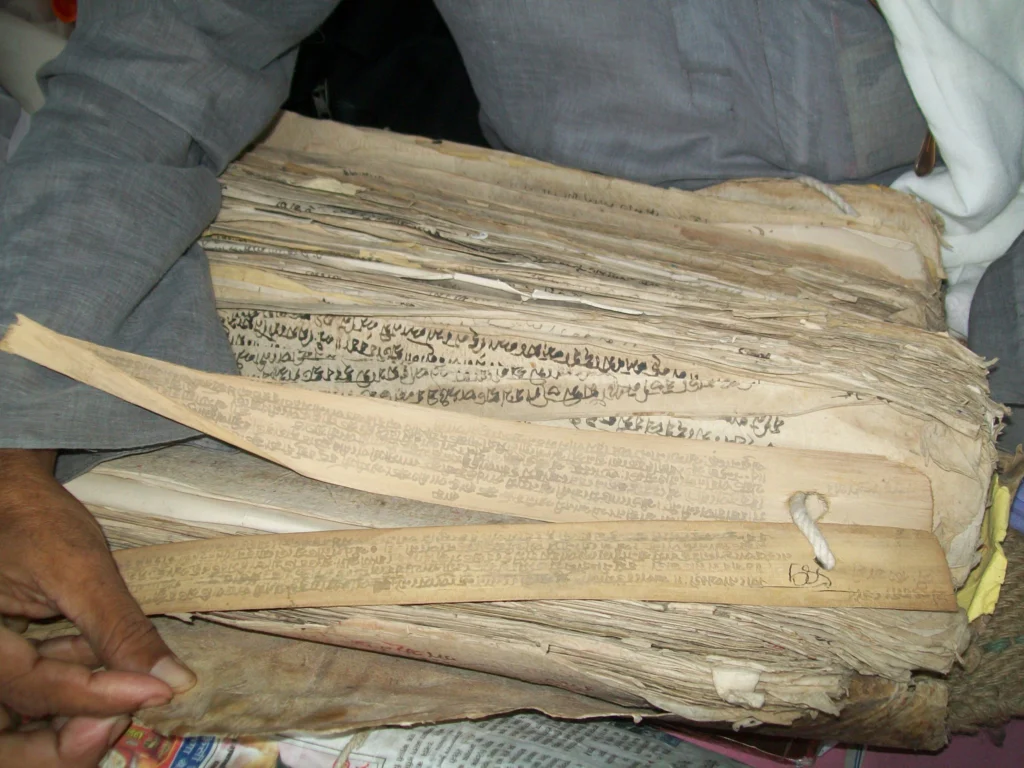
Among Maithil Brahmins and Kayasthas, marriages have traditionally been checked against genealogical records called panji. These records, kept by specialist genealogists known as panjikars, trace family lines over many generations so that couples who are too closely related do not marry. Tradition attributes the introduction of the panji system to Harisimhadeva, a king of the Karnat dynasty of Mithila in the early 14th century.
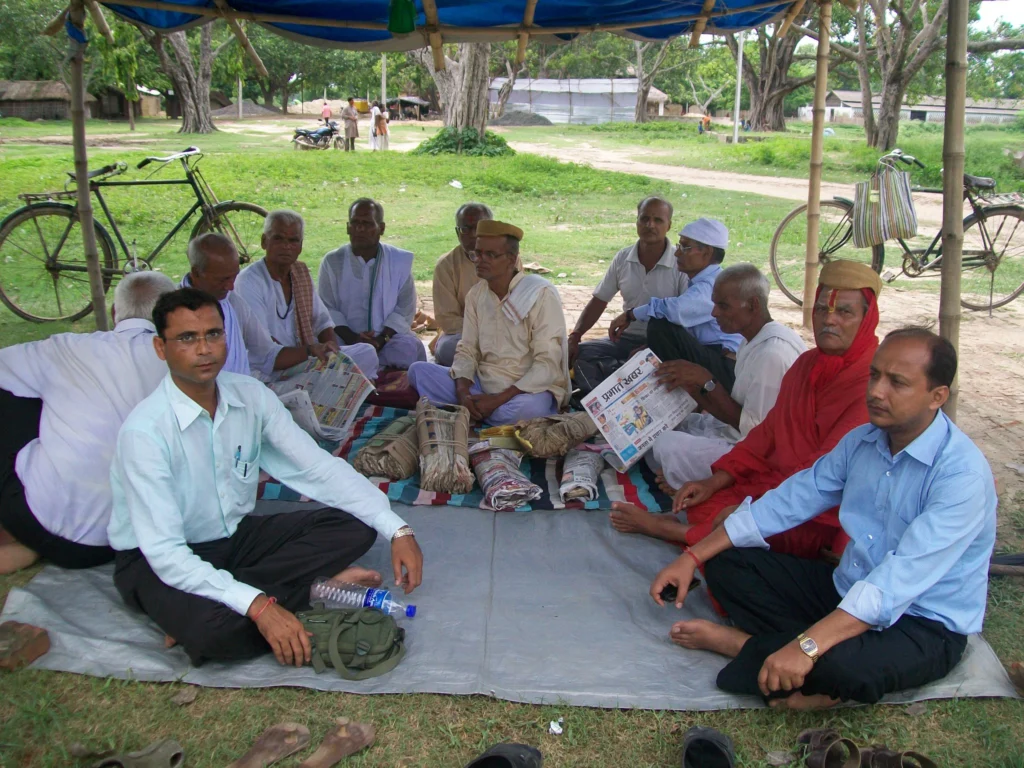
The most famous place where marriages were arranged is Saurath, a village about 6 km northeast of Madhubani. For centuries, thousands of Maithil Brahmin families gathered every year in a large mango orchard there, known as the Sabha Gachhi, during the auspicious months of Jyeshtha and Ashadha (around May to July). Each village had its fixed place, or dera, in the grove. The fathers or guardians of prospective brides met the families of grooms in the open, with the help of relatives and middlemen, and once a match was agreed, a panjikar issued a certificate confirming that the two families were not related within the forbidden degrees.
Fourteen villages once held such sabhas, but only Saurath and Sasaula have kept the tradition alive, and the gathering at Saurath is much smaller than it once was. Critics have long pointed out that it was a gathering of men, from which women were excluded, and that it was sometimes described as a groom market.
Before the wedding
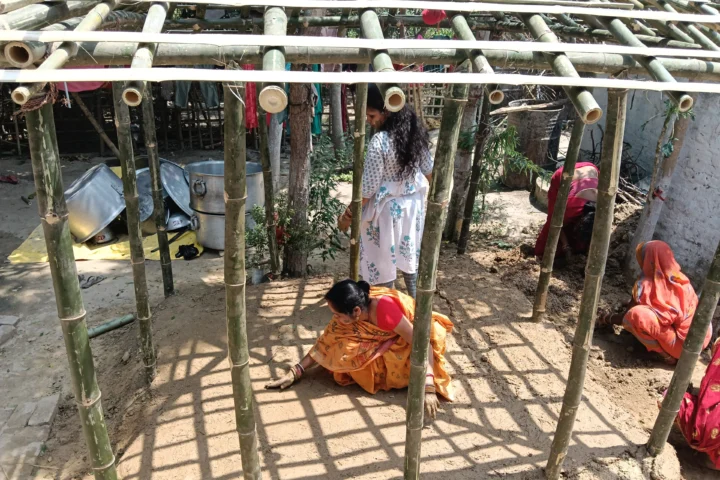
Once a match is fixed, the preparations begin. In the courtyard of the bride’s home, a marwa, a pavilion of bamboo and leaves, is built for the rituals. Women draw aripan, auspicious floor patterns made with rice paste, which are meant to welcome the gods. A sequence of rituals follows, each with its own songs. One of the first is matkor, in which women of the family go out to dig earth and worship it at the start of the wedding. Others include haldi, the turmeric ceremony, and blessings such as chumavan, in which elders bless the couple with durva grass and rice while chanting mantras.
The wedding
On the wedding day, the groom arrives with the baraat, his wedding party, traditionally wearing a paag, the distinctive Maithil headdress. When he arrives, the women of the bride’s family welcome him with parichhan, a ritual of greeting and good-humoured questioning accompanied by parichhan songs. The ceremonies take place under the marwa, with a priest chanting mantras around a sacred fire. The most important moment for many families is sindoor daan, when the groom applies vermilion to the parting of the bride’s hair. Mithila paintings of weddings show many of these scenes: a veiled bride, a groom in a dhoti and flower veil, a priest, the sacred fire, and women attending the bride.
The kohbar
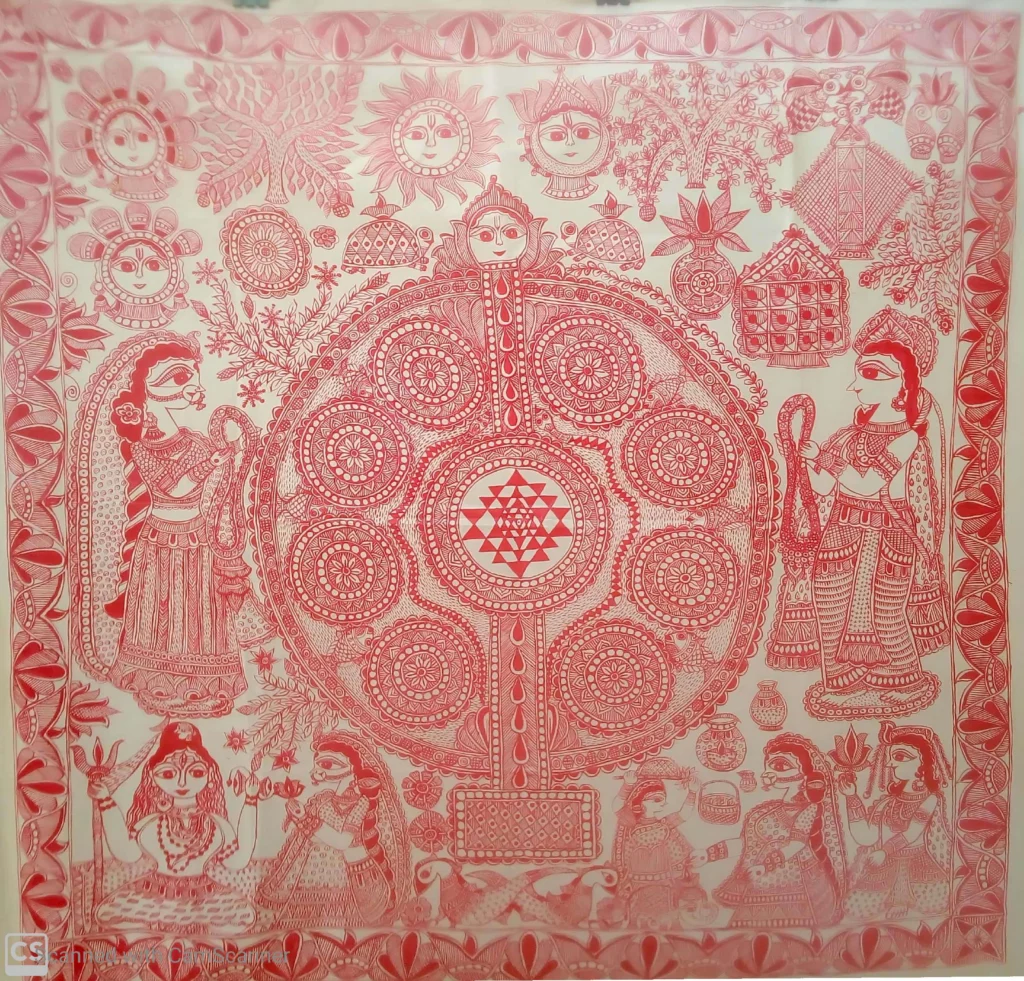
The most distinctive feature of a Mithila wedding is the kohbar ghar, the nuptial chamber. Its walls are painted by the women of the bride’s family with kohbar paintings, which are full of symbols of fertility, love and long life. According to Sahapedia, these include a large central lotus-like mandala surrounded by smaller ones, bamboo, betel leaves, banana trees, pairs of parrots for love, fish, serpents for regeneration, elephants for strength, peacocks for eternity and tortoises for longevity, along with the sun and the moon. Four figures of Naina Jogin, a protective veiled goddess, are painted on the walls to guard the couple from the evil eye. Kohbar paintings are typically made in red, or in red with yellow or blue, and unlike much Mithila art, black is not used.
On the first night after the wedding, the bride and groom enter the kohbar, where family members crowd in to watch them play games and perform playful rituals that serve as icebreakers. For the next four days, the couple worship the goddess Gauri every morning. The marriage is considered complete only after the chaturthi rites at the end of this period, when certain rituals are repeated and the groom again applies sindoor to the bride’s parting. The bride honours the kohbar by offering vermilion and leaving a print of her turmeric-dipped hand on it. A 2026 study in the Indian Journal of Traditional Knowledge by researchers at NIT Patna describes the kohbar ghar as an important element of Mithila’s living heritage, but warns that migration and shortened wedding ceremonies are causing the tradition to decline.
After the wedding
A Mithila marriage continues to be marked long after the wedding day. In gauna (or gowna), the bride is sent to her husband’s home, traditionally in a palanquin, now usually by car. In the first monsoon after the wedding, many new brides observe Madhushravani, a fortnight of worship and storytelling in which the husband also takes part. In the autumn, the groom’s family celebrates Kojagara, distributing makhana and betel sent by the bride’s family. Both are described in our story on Bihar’s lesser-known festivals.
The role of women and songs
Women are at the centre of a Mithila wedding. They paint the kohbar and the aripan, make the sikki boxes and other gifts, lead many of the rituals and, above all, sing. Every stage of the wedding has its songs, from teasing songs for the groom’s party to the heartbreaking samdaun sung when the bride leaves home. These are described in our story on the wedding songs of Bihar.
Significance
Mithila weddings are important not only as family events but as carriers of culture. The kohbar and aripan are the roots of the region’s famous painting tradition. The songs preserve the Maithili language and its poetry. The rituals express ideas about family, fertility and protection that go back centuries. A wedding is also the moment when a whole community, relatives, neighbours and village, comes together.
Variations
Customs vary between castes, villages and families. The panji and Saurath Sabha are traditions of Maithil Brahmins and Kayasthas, while other communities have their own ways of arranging marriages. The details of rituals, the order of ceremonies and the songs sung also differ from place to place.
Facts worth knowing
- Saurath Sabha takes place in a mango orchard about 6 km northeast of Madhubani.
- Of the fourteen villages that once held marriage sabhas, only Saurath and Sasaula still do.
- Kohbar paintings avoid black, using red with yellow or blue.
- Sikki boxes for sindoor are a traditional part of Maithil weddings.
How Mithila weddings are changing
Like weddings everywhere, Mithila weddings have changed. Ceremonies are shorter, especially for families who live in cities. Professional decorators, printed kohbar designs and recorded songs have replaced some of the work once done by women of the family. Saurath Sabha has declined as couples meet through families, matchmakers and online platforms. Yet many families still paint the kohbar, sing the old songs and follow the main rituals, and some urban couples travel back to their villages to marry in the traditional way.
Conclusion
A Mithila wedding is a celebration of family, art and song, stretched across days and seasons. Its painted kohbar, rice-paste aripan and courtyard songs make it one of the most beautiful wedding traditions in India. If you are ever invited to one, accept: you will see Mithila’s culture at its most joyful.