Bihar’s Forgotten Festivals and Traditions
Madhushravani, Chaurchan, Jur Sital, Kojagara, Bihula-Bishahari and Sohrai: lesser-known festivals still kept in the homes and villages of Bihar.
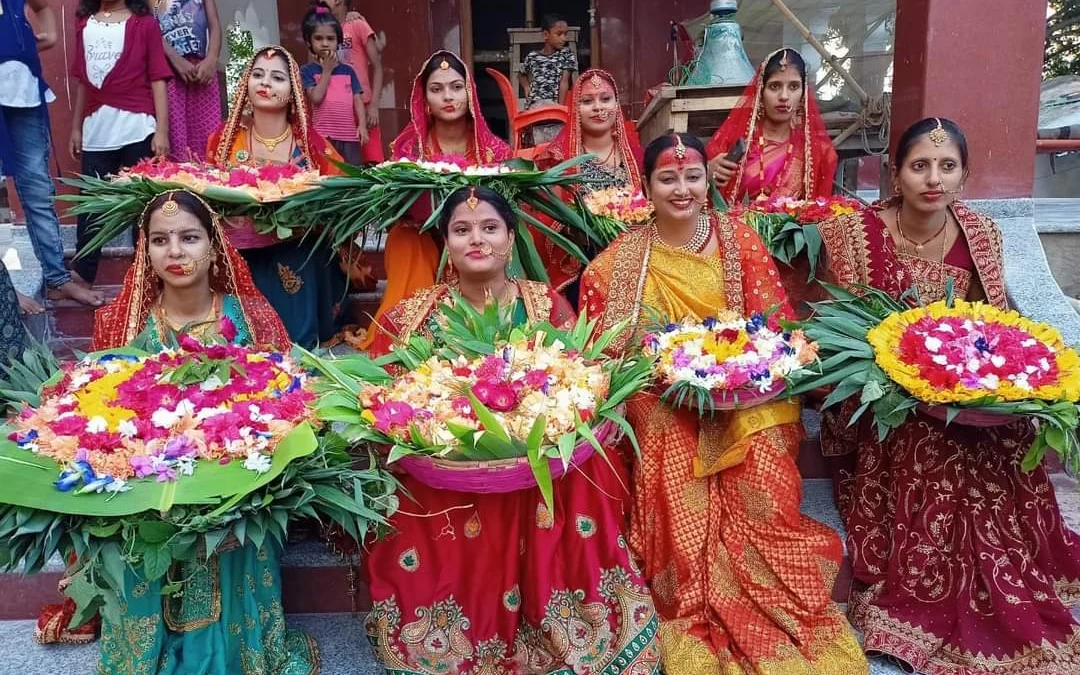
Ask anyone about Bihar’s festivals and they will name Chhath first, and then perhaps Holi, Diwali or Durga Puja. But the state’s calendar is far richer than its best-known celebrations. In the villages of Mithila, Anga and the south of the state, families still keep festivals that most of India has never heard of: a fortnight of songs for new brides, a night of prayer to the moon, a new year greeted with rice and lentil cakes, and a goddess of snakes honoured with painted boxes.
These festivals are not truly forgotten. They are kept, faithfully, by the communities that inherited them. But they rarely appear in tourism brochures or national holiday lists, and some are fading as families move to the cities. Here are some of the most remarkable.
Madhushravani: a fortnight for new brides
Madhushravani is one of the most distinctive festivals of Mithila. It is observed by newly married women, traditionally among Maithil Brahmin families, in the first monsoon after their wedding. The festival lasts about two weeks in the month of Shravan (Sawan, roughly July to August), from the fifth day of the dark fortnight to the third day of the bright fortnight.
Custom requires the bride to wear clothes and jewellery sent by her in-laws, and the materials for the puja also arrive from her husband’s family the day before it begins. Each morning the bride and her friends pluck flowers and leaves. They worship clay images of Bishahari (the snake goddess), Naga and Nagin, Gauri and elephants, and listen to stories told in fourteen parts, including the marriage of Shiva and Parvati, the story of the Ganga and the story of Bihula. In the evenings, women sing Madhushravani songs and kohbar songs. According to tradition, Parvati herself first kept this observance to have Shiva as her husband in every birth.
On the last day comes a ritual known as the temi, in which small burning cotton wicks are placed on the bride’s knees and feet over betel leaves. It is regarded as a test of the bride’s steadiness and devotion.
Chaurchan: worshipping the moon
Chaurchan, also called Chauth Chand, is observed by women in Mithila on the fourth day of the bright fortnight of Bhadrapada (usually in August or September), the same day as Ganesh Chaturthi elsewhere in India. Its name is a Maithili form of chauth chandra, the moon of the fourth day.
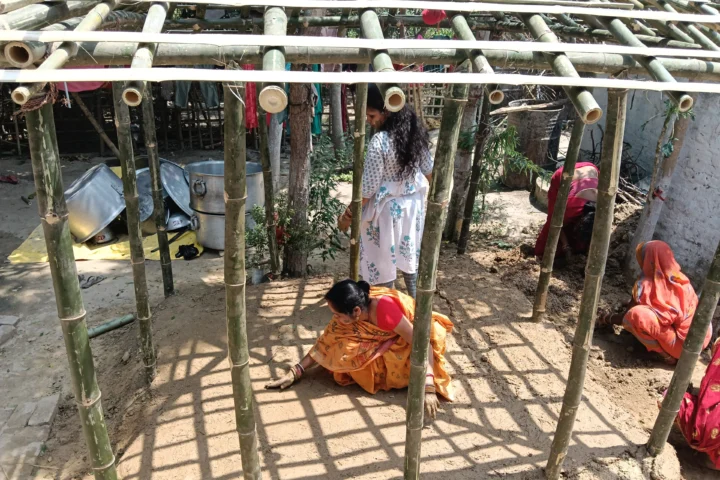
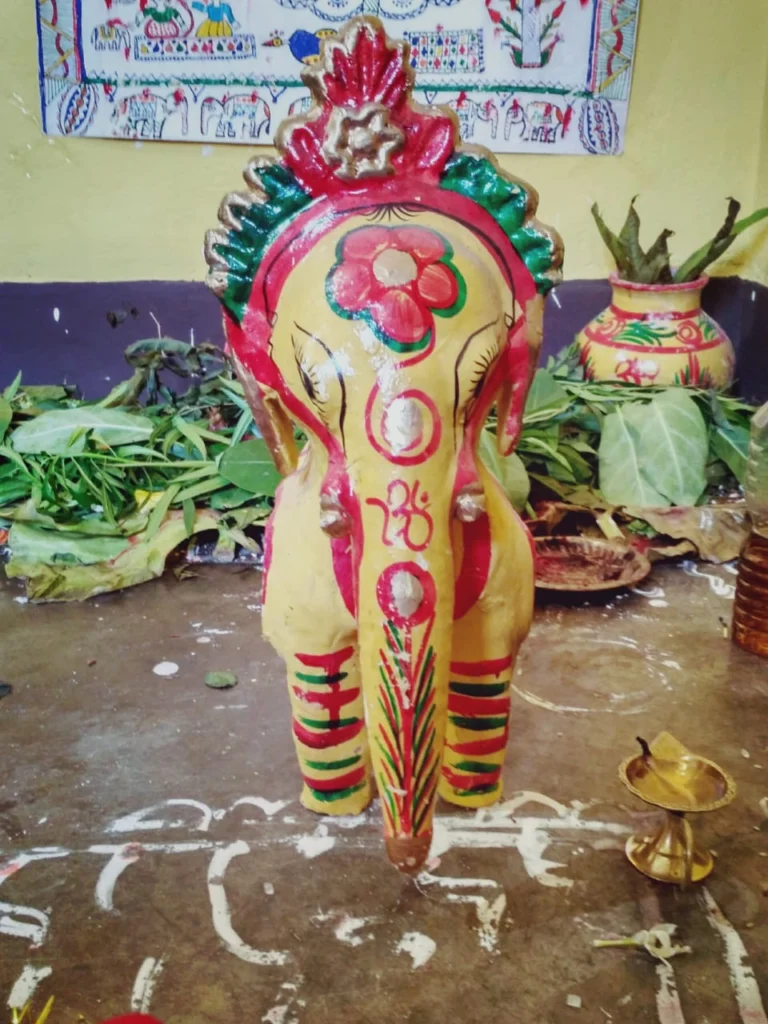
During the day, women fast. The courtyard is cleaned and smeared with cow dung, and aripan, the ritual floor drawings of Mithila, are made with rice paste. Dishes of kheer, sweets, fruit, curd and puris are laid out on banana leaves. In the evening, women turn towards the rising moon and offer arghya, holding the offerings in their hands while reciting a Sanskrit verse about the Syamantaka jewel.
The festival rests on a belief that worshipping the moon on this day protects against false accusations. In the Puranic story, the moon is cursed by Ganesha for mocking him, and anyone who sees the moon on this day risks being wrongly blamed, just as Krishna was falsely accused of stealing the Syamantaka jewel. A popular account in Mithila links the festival to Hemangad Thakur, a 16th-century ruler of the region who was imprisoned by the Mughals for unpaid taxes and was said to have won his release with an astronomical work on eclipses. This story is widely told, but it should be read as tradition rather than established history.
Jur Sital: the Maithili new year
Jur Sital, also called Maithil New Year, marks the start of the year in the Tirhuta (Mithila) calendar. It falls on Mesh Sankranti, usually 14 or 15 April, the same day that many other regional calendars in India begin their year. Maithil families traditionally eat bori (lentil dumplings) with rice and sweets on the day.
The name suggests coolness, and among the Tharu people of the Nepal Terai, who call the festival Siruwa, elders sprinkle water on the heads of the young as a blessing, while the young touch water to the feet of their elders as a mark of respect.
Kojagara: the night of staying awake
On the full moon of Ashvin, usually in October, much of eastern India keeps Kojagari Purnima, when the goddess Lakshmi is believed to visit homes and bless those who stay awake. In Mithila the festival has a special meaning for new marriages. Kojagara is celebrated with particular joy in the home of a newly married groom. His family distributes makhana (fox nuts) and betel, sent by the bride’s family, among relatives and neighbours. In Bihar, as in much of north India, kheer is also left under the moonlight overnight and eaten the next day as prasad.
Bihula-Bishahari Puja: the goddess of snakes
In the Anga region around Bhagalpur, the monsoon brings the festival of Bishahari, the snake goddess also known as Manasa. Devotees offer her manjushas, temple-shaped boxes made of bamboo, jute and paper and painted with the story of Bihula, the young bride who brought her husband Bala back to life after he was killed by a snakebite on their wedding night. The legend comes from the medieval Manasamangal tradition, composed in several languages of eastern India between the 13th and 18th centuries. Bihar’s state government notes that the Bihula-Bishahari Gatha was once widely sung in Bhagalpur, though few people sing it today. The paintings on the boxes gave rise to Manjusha art.
Sohrai: honouring the cattle
Sohrai is a harvest festival of Adivasi communities including the Santal, Oraon, Munda and Ho, celebrated in Jharkhand and in parts of Bihar, West Bengal and Odisha. It is often called the cattle festival. In many places it falls on the new moon of Kartik, around Diwali, while in the Santal Parganas it is held in January. Cattle are bathed, their horns anointed with oil and vermilion, and lamps are lit in the cowsheds. Women repaint the mud walls of their homes with murals that welcome the harvest. For communities in the south and east of Bihar, Sohrai is a reminder that the state’s culture includes Adivasi traditions as well as those of the Gangetic plain.
What these festivals share
These festivals come from different communities and seasons, but they have features in common. Many are kept by women, in homes and courtyards rather than temples. Most are tied to the agricultural year: the monsoon, the harvest and the turning of the seasons. They depend on oral tradition, with songs and stories passed from grandmothers to granddaughters, and on handmade objects, from clay images and aripan drawings to painted boxes. That is also why they are fragile. When families move away and the songs are not passed on, a festival can disappear in a generation.
How they are changing
Some of these festivals are reviving. Madhushravani and Sama-Chakeva are now featured in cultural programmes and on social media, and women who have moved to cities often keep them in simplified forms. Manjusha painting has found a new life as a craft. Others are changing in ways that worry their custodians, as fewer young people learn the songs and ready-made materials replace handmade ones. Documentation by museums, scholars and community groups has become an important way of keeping a record of what these festivals involve.
Facts worth knowing
- Madhushravani is one of the few Indian festivals observed specifically by newly married women in the first year of marriage.
- The Tirhuta calendar of Mithila begins its year on Mesh Sankranti, in mid-April.
- Manjusha boxes made for the Bishahari festival are the origin of Bhagalpur’s Manjusha painting.
- Sohrai wall paintings, made by women in Adivasi villages, are part of a tradition of mural art that spans eastern India.
Conclusion
Bihar’s lesser-known festivals are small in scale but rich in meaning. They tell us about the lives of women in Mithila, about the agricultural rhythms of the countryside, and about the many communities that make up the state. To see them, you usually have to be invited into a home or a village. If you are, take the chance. You will see a side of Bihar’s culture that few visitors ever do. For more festivals of Mithila, read about Sama-Chakeva, Jitiya and Vivah Panchami.