Tikuli Art: A Traditional Craft of Bihar
From glass-and-gold bindis in Mughal-era Patna to glossy enamel paintings made by thousands of women. The story of Bihar’s Tikuli art.
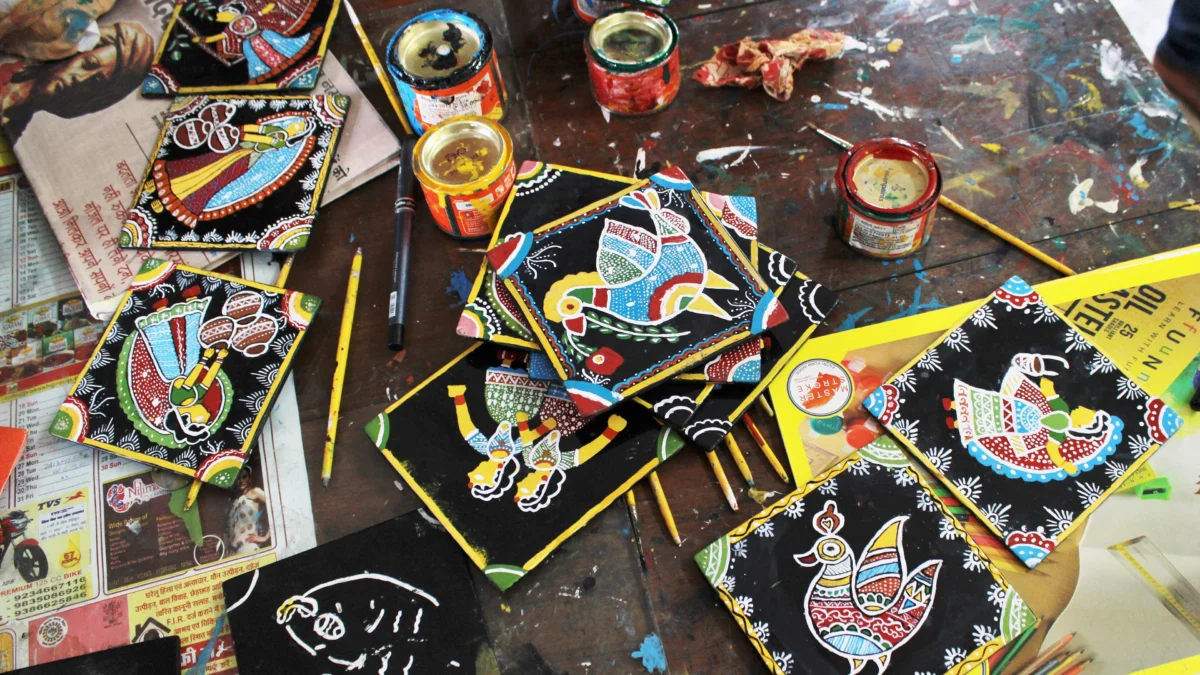
A tikuli is a small ornament worn on the forehead, the word used in Bihar for a decorative bindi. Centuries ago, in the city that is now Patna, tikulis were made by melting glass, painting it with fine patterns and covering it with gold leaf, so that each one sparkled like a jewel. The jewellery trade faded, but the technique and its look survived in a different form: as Tikuli art, a style of bright, glossy miniature painting that is today one of Bihar’s recognised handicrafts.
History and origins
The Government of Bihar describes Tikuli art as a highly distinctive traditional art form that is believed to have originated around 800 years ago in the region around Patna, and to have received patronage during the Mughal period. That figure of 800 years is part of the craft’s tradition and is difficult to verify. The more widely documented account is that the elaborate making of tikulis flourished in Patna during the Mughal era, especially around the 17th century.
According to the state government, making a single tikuli in earlier times was an intricate process. Glass was melted in a furnace and cut into shape, overlaid with gold or silver foil, and then etched with images of deities, natural motifs and other designs. A single tikuli could take seven to ten days to make. These ornaments were prized by women of royal and aristocratic families. A Patna-based art critic told VillageSquare that tikulis were once produced on a large scale in Patna and sent to cities such as Kanpur and Delhi, with buyers also coming to Bihar to buy them.
Over time, craftsmen began to apply the same materials, motifs and glossy finish to small decorative pieces, and these too came to be called tikuli. As royal patronage declined, and as cheaper mass-produced bindis replaced handmade ones, the craft almost disappeared.
Revival in the 20th century
The revival of Tikuli art is closely linked with Upendra Maharathi, the artist who founded the institute in Patna now known as the Upendra Maharathi Shilp Anusandhan Sansthan. Accounts credit him with reviving the craft from around 1950. After his death in 1981, the artist Ashok Kumar Biswas continued the work of training artisans and building interest in the art.
A widely repeated story from this period concerns the Asian Games held in Delhi in 1982. According to artists involved in the revival, quoted by VillageSquare, tikuli pieces were presented as official mementoes to the athletes taking part, a boost that brought the craft national attention. The Government of Bihar also names Ambika Devi, whom it describes as a Padma Shri awardee, as having played a pivotal role in bringing recognition to Tikuli art at national and international levels.
How Tikuli art is made today
Modern Tikuli art no longer uses molten glass. Instead, artists work on hardboard or fibreboard, which is cut into shapes such as circles, ovals and rectangles and smoothed. Several coats of black enamel are applied to create the dark, glossy background that gives tikuli its look. The design is then drawn and painted in bright enamel colours, mostly crimson, yellow, cobalt blue and deep green, according to Ashok Kumar Biswas. Gold or golden paint is used for borders and highlights, echoing the gold foil of the original ornaments.
The themes include gods and goddesses, scenes from mythology, festivals, village life and customs, as well as birds, fish, flowers and trees. Biswas has noted that tikuli has “a shadow” of Madhubani techniques, and many artists today combine tikuli’s glossy finish with motifs drawn from Madhubani painting.
What is made
Tikuli art is used for wall plates and wall hangings, coasters, table mats, trays, boxes, pen stands, jewellery, mobile phone holders and other decorative and utility items. These smaller, affordable products have helped the craft find buyers among tourists and city customers.
The artisans
Tikuli art is now overwhelmingly a women’s craft. Ashok Kumar Biswas told VillageSquare that about 98 percent of the roughly 7,000 tikuli artisans are women, many working from home. That report told the story of Sumitra Devi of Nargadda village in Bhojpur district, who said that learning Tikuli art around two decades earlier transformed her family’s finances, paying for her four daughters’ schooling and replacing a mud hut with a two-storey house. Her married daughters continue to make tikuli at home.
A director of the Upendra Maharathi institute told the same report that about a decade earlier there had been only around 300 active artisans, most of them women, because many had left the craft for lack of income, and that training programmes and fairs were organised to revive it.
Significance
Tikuli art is significant in a few ways. It is one of the few crafts of Bihar with an urban origin, in the workshops of old Patna rather than in villages. It connects with the history of personal adornment in Bihar, and it shows how a craft can survive by changing form, from forehead jewellery to painting. Its revival is also an example of how state institutions and individual artists can work together to bring a nearly lost craft back.
Variations and influences
Tikuli artists vary in style. Some work in a traditional manner, with black grounds, gold borders and fine detail. Others borrow freely from Madhubani and other folk styles, while some experiment with new colour schemes and products. Because the craft is practised mainly in Patna and surrounding districts, including Bhojpur, there is a strong shared visual vocabulary.
Facts worth knowing
- “Tikuli” is the local word for a bindi, the ornament worn on the forehead.
- In the old method, a single tikuli could take seven to ten days to make, according to the Government of Bihar.
- Modern tikuli is painted with enamel colours on hardboard, usually over a glossy black background.
- The craft’s 20th-century revival is credited to Upendra Maharathi and, after him, Ashok Kumar Biswas.
Tikuli art in modern Bihar
Tikuli products are sold in Bihar’s state emporiums, at handicraft fairs, in Patna’s shops and online. The craft has also suffered setbacks, including during the Covid-19 pandemic, when fairs and exhibitions were cancelled. Still, it has a secure place among Bihar’s crafts, alongside sikki and Manjusha, and it offers many women a way to earn at home.
Conclusion
Tikuli art began as a jewel for the forehead and became a painting tradition. Its glossy black surfaces, bright colours and gold borders carry a memory of Mughal-era Patna, while the women who make it today have made it their own. If you are in Patna, look for it in the city’s craft shops: a small tikuli plate is one of the most distinctive souvenirs Bihar has to offer.