Manjusha Art: The Forgotten Art of Bhagalpur
Snakes, bold borders and the story of Bihula. How Bhagalpur’s Manjusha art grew from a monsoon festival, nearly vanished and won a GI tag.
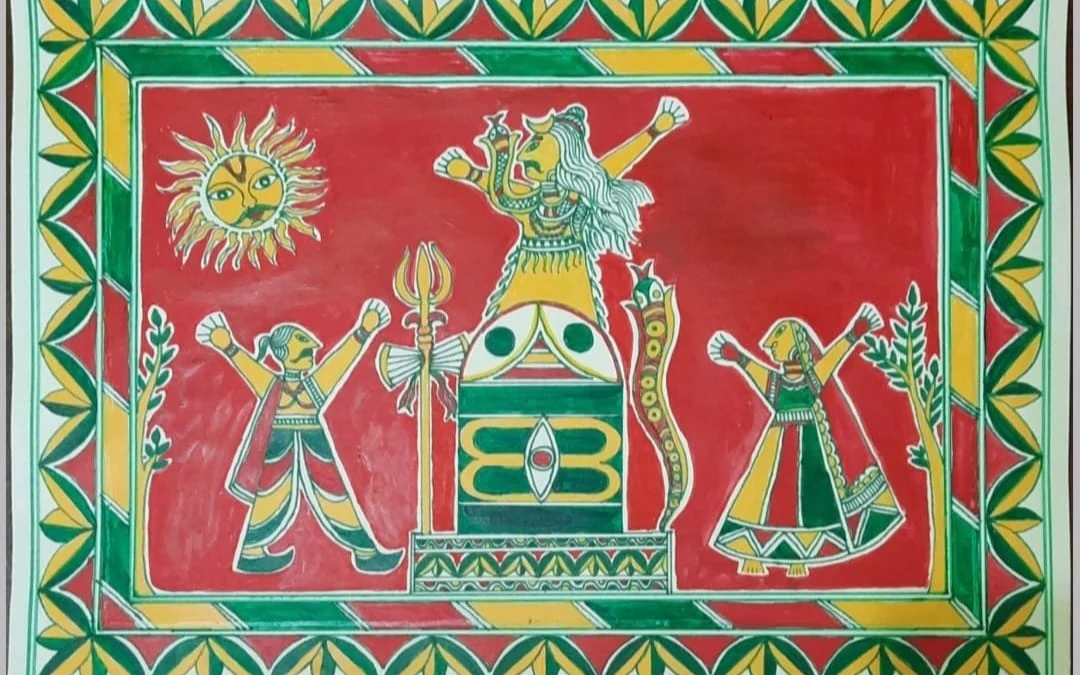
Most people who know Bihar’s folk art know Madhubani. Far fewer know that a second, very different painting tradition grew up a couple of hundred kilometres to the southeast, in the region around Bhagalpur that was once the ancient kingdom of Anga. Its figures are drawn in bold outlines, its palette is limited to a few colours, and its pictures are crowded with snakes. This is Manjusha art, a painting tradition so closely tied to a single story and a single festival that, for a long time, it hardly existed outside them.
What the word means
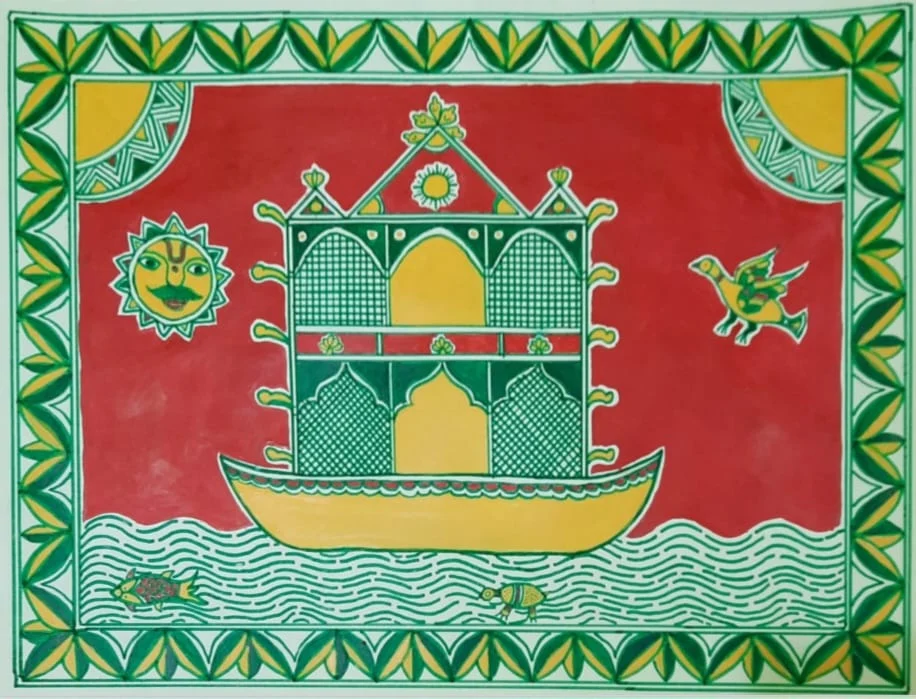
In Sanskrit, manjusha means a box or chest. Traditionally, manjushas are temple-shaped boxes made of bamboo, jute and paper, usually with eight pillars, into which devotees put their ritual offerings. The outsides of these boxes are painted with scenes from a folk legend. Over time, the name of the box came to be used for the painting style itself, which is also known as Manjusha Kala, Angika painting and, among foreign collectors, “snake painting”.
The story of Bihula and Bishahari
Every Manjusha painting tells, or draws from, one story: the tale of Bihula and Bishahari. It belongs to the Manasamangal tradition of eastern India, a group of medieval poems in praise of Manasa, the snake goddess, composed between roughly the 13th and 18th centuries in Bengali, Assamese, Angika and other languages. In the Anga region the goddess is known as Bishahari.
In the story, the merchant Chandu Saudagar (Chand Sadagar) of Champanagar refuses to worship Bishahari. In revenge, the goddess kills his sons one by one. When his youngest son Bala (also called Lakhindar) marries Bihula, the family builds a sealed iron chamber for the wedding night, but a snake still finds a way in and Bala dies. Bihula refuses to accept his death. She sets off on a raft down the river with her husband’s body, endures many trials and finally reaches the court of the gods, where her devotion and her dancing win back Bala’s life. In return, Chandu Saudagar agrees to worship Bishahari.
This is a legend, not a historical account. But it is rooted in a real place. Champanagar, now part of Bhagalpur, is associated with Champa, the ancient capital of Anga, and the people of the region regard the story as their own.
History and origins
Manjusha art is often said to date back to around the 7th century, a claim repeated by the Government of Bihar and by many writers on the subject. There is no surviving painting of that age to prove it, so the date is best understood as a statement of the tradition’s antiquity rather than a precise historical fact. What is certain is that the art grew out of the Bishahari Puja, a festival for the snake goddess usually held in August, during the monsoon, when snakes are most active and snakebite was a real fear in rural Bihar.
Traditionally, the paintings were the work of particular families. Accounts of the art associate it with the Malakar (Mali, or gardener) community, who made the boxes for the festival. The Bihula-Bishahari Gatha, the long sung version of the story, was once performed widely in Bhagalpur, though the state government notes that few people still sing it.
Outside recognition came early but slowly. W. G. Archer, a British civil servant in Bihar between the 1930s and 1940s who also championed Madhubani painting, collected Manjusha paintings and admired their boldness, comparing them to modern art. Some of the paintings he collected went to the India Office Library in London.
How Manjusha art is painted
Manjusha art has a distinct visual grammar:
- Few colours. Traditionally only three colours are used, described in Bihar’s Geographical Indication record as pink, green and yellow. Some accounts describe the reds and greens as set against a dark ground.
- Line drawing. Figures are drawn in strong outlines and filled with flat colour.
- Borders. Borders matter as much as the main picture. Common ones include belpatra (bael leaves), lahariya (waves), triangles, mokha and chains of snakes.
- Stylised figures. People are often drawn in a posture resembling the letter X, with large eyes and simplified bodies.
- Recurring motifs. Snakes appear everywhere, along with the champa flower, the sun, moon, elephants, turtles, fish, the maina bird, lotus, kalash pot, bow and arrow, shivling and trees.
- Recurring characters. Shiva, Bishahari (Mansa Devi), Bihula, Bala, Hanuman and Chandu Saudagar.
Because it tells a story in a series of panels, Manjusha art is often described as a scroll painting, and the Government of Bihar describes it as the only art form in India with a sequential representation of a story displayed in a series.
People and places
The centre of the art is Bhagalpur, especially Champanagar and the surrounding villages, with practitioners in neighbouring districts such as Banka and Munger. Chakravarti Devi of Champanagar is remembered as one of the last painters of the older generation, at a time when the art was close to disappearing. According to accounts of the art’s recent history, she was honoured with Bihar’s Sita Devi Award in 2012. Manoj Pandit received the first state award for reviving Manjusha art and the Manjusha Kala Guru award in 2014. Artists such as Nirmala Devi and Ulupi Jha have also been recognised for their work.
Significance
Manjusha art matters for several reasons. It is one of the few painting traditions in India that is tied so closely to a single narrative, and it preserves, in pictures, a story that is part of the shared heritage of Bihar, Bengal and Assam. It is also a record of Anga’s distinct identity, separate from Mithila’s, with its own language, Angika, and its own festivals.
Decline and revival
For much of the 20th century Manjusha art was in decline, as the old ritual uses faded and painting brought little income. The Government of Bihar records that in 1984 a public programme took slideshows of Manjusha paintings to the villages of Bhagalpur to encourage people to revive the tradition. Since then, government bodies and voluntary organisations have run workshops, and the Upendra Maharathi Shilp Anusandhan Sansthan in Patna has trained artists.
A major milestone came in 2021, when Manjusha art received a Geographical Indication (GI) tag. The application was filed by the Upendra Maharathi Shilp Anusandhan Sansthan in 2019, and the certificate was issued on 14 September 2021. The GI record notes that designs are now reproduced on cloth and handmade paper and adapted for clothing, home furnishings and decor.
Manjusha art in modern Bihar
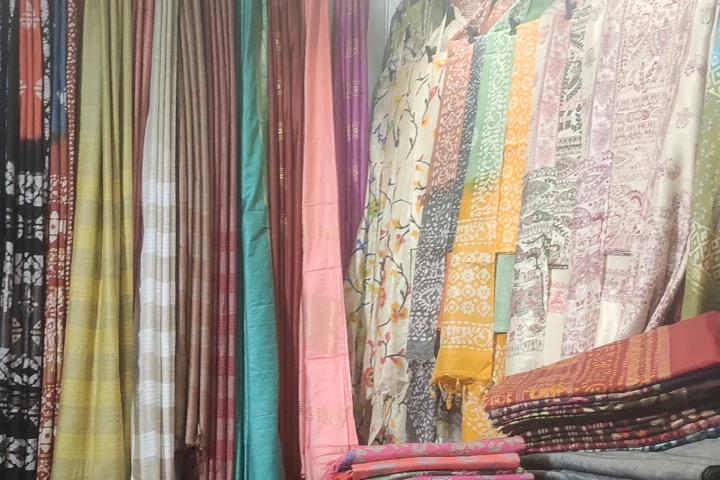
Today, Manjusha motifs appear on saris and silk stoles, cushion covers, bags, greeting cards and public murals, and many of the new artists are women who have learned the art through training programmes. The combination of Manjusha designs with Bhagalpur silk has been especially successful, joining two of the region’s best-known crafts.
Facts worth knowing
- Manjusha means “box” in Sanskrit, after the painted temple-shaped boxes used in the Bishahari festival.
- Manjusha art received a GI certificate on 14 September 2021.
- The art traditionally uses only three colours and gives great importance to its borders.
- Its legend of Bihula is also told in Bengal and Assam, where the heroine is known as Behula.
Conclusion
Manjusha art is a reminder that Bihar’s folk painting is not one tradition but several. Its snakes, borders and determined heroine tell a story of a woman who would not give up, and the art itself has had to show the same persistence to survive. To read more about the festival the boxes were made for, see our story on Bihar’s lesser-known festivals, and compare it with Madhubani painting from Mithila.