Sikki Art: The Golden Grass Craft of Bihar
Wild wetland grass, a single needle and generations of women’s skill. How the golden sikki grass of Mithila is coiled into boxes, toys and gods.
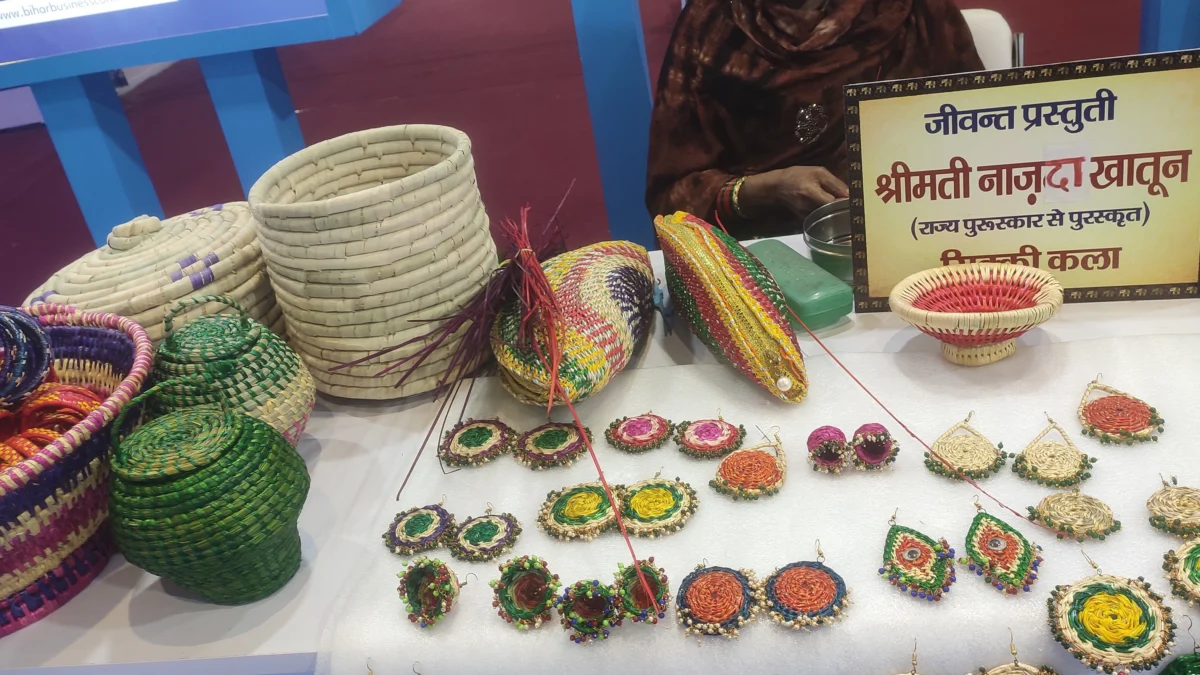
In the wetlands of north Bihar grows a tall, slender grass that dries to the colour of old gold. For generations the women of Mithila have harvested it, split its stalks with their fingernails and coiled it into boxes, baskets, toys and images of the gods. The grass is called sikki, and the craft made from it is one of the quietest treasures of Bihar: sustainable, intricate and almost entirely the work of women.
A craft from the wetlands
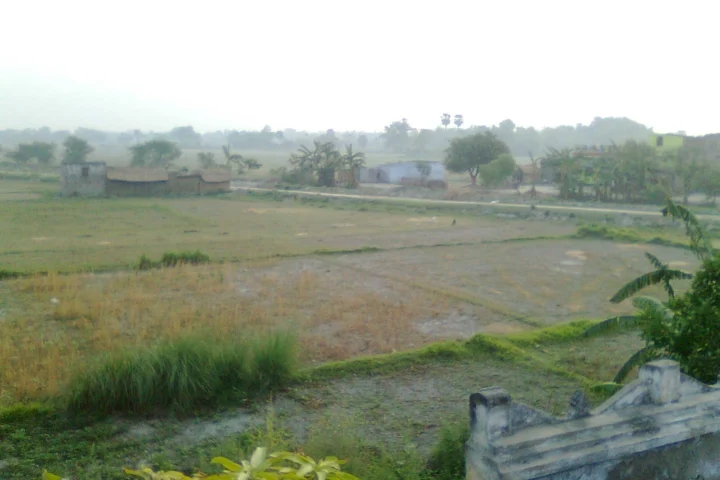
Sikki grows in the wet and marshy areas of Madhubani district and other parts of north Bihar, a landscape of ponds, flood plains and fields that also produces makhana and paddy. According to the Global InCH encyclopedia of intangible heritage, the grass is cut during the rainy season, near its base, and then dried. The flowering top of the stem is discarded, and each stalk is split into fine strips that are used for weaving. Traditionally, sikki was not even sold by weight but by the fistful, each fist holding some 30 to 35 split stalks.
History and origins
Nobody knows exactly how old the craft is. The Government of Bihar describes sikki work as an integral part of the living heritage of Mithila’s women, and says it has existed for hundreds of years, while noting that its commercial use is much more recent, dating from the last few decades.
Sikki work was traditionally one of five crafts in which a young woman of Mithila was expected to be skilled. The others were painting (now famous as Madhubani painting), Sujni embroidery, kashidakari embroidery and papier mache. A girl’s skill in these crafts was valued when marriages were arranged, and the objects she made went with her to her husband’s home.
How sikki objects are made
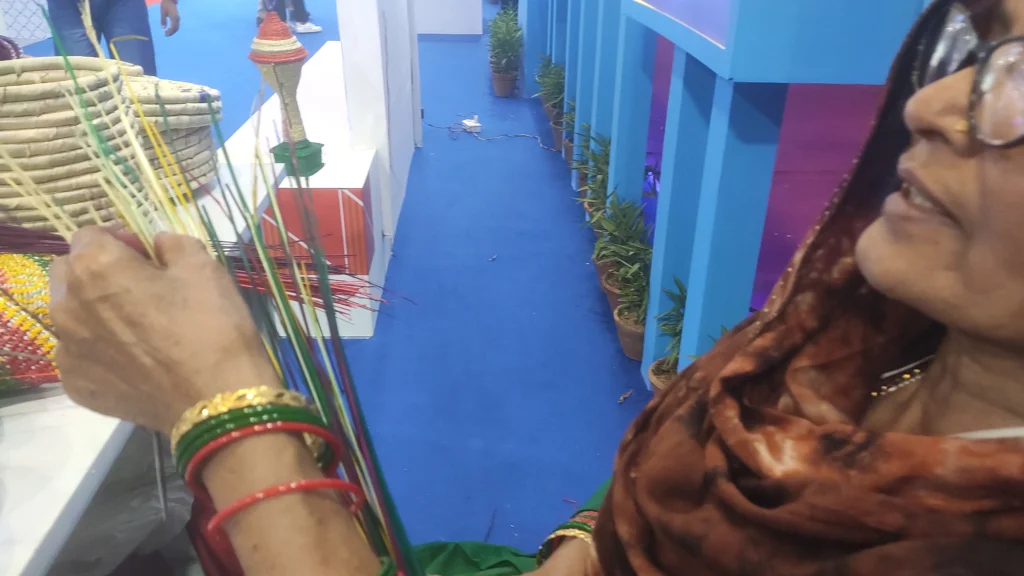
The technique is coiling, one of the oldest basket-making methods in the world. The basic shape of an object is first formed from munj grass (Saccharum munja), which is cheaper, stronger and more abundant. This core is then wound completely with sikki so that the munj is hidden. The craftswoman uses a single tool, a needle-like iron awl about six inches long called a takua, with a rounded handle made of lac. She holds the object in one hand and uses the takua to open the coils and pull the sikki through. No thread, cord or glue is used, and the grass is moistened lightly to make it pliable.
For colour, the grass is boiled in dyes. Natural gold sikki is often combined with strips dyed in pink, red, green, purple and blue to create patterns, borders and figures.
What is made from sikki
Sikki products have always been both useful and sacred. Women make containers for grain, rice, lentils and spices, boxes for jewellery and clothes, baskets for sweets and betel, bangles for themselves, and toys, masks and dolls for children. Boxes with lids shaped like elephants or peacocks are especially popular.
The craft is closely tied to weddings. Ornate sindoor (vermilion) boxes made of sikki are a traditional part of Maithil weddings, according to a 2025 Government of India factsheet, and sikki boxes filled with dry fruits and auspicious items are gifted to daughters at marriage. Women also make figures of deities, from Ram, Sita and Lakshman to Ganesh, Durga, Hanuman, Saraswati and Lakshmi, for worship at home during festivals.
For city buyers, artisans now make coasters, table mats, fans, pen stands, mirror frames, phone cases and three-dimensional figures, and some have begun to work with sikki alone, without a munj core, to produce finer and more flexible pieces.
The women who keep the craft alive
Sikki work is overwhelmingly done by women, usually learned from a mother or mother-in-law. The Global InCH encyclopedia describes Meera Thakur, who learned from her mother Gucchi Devi of Umri village, and how Gucchi Devi trained other women, sold their work at exhibitions and fairs as far away as Mumbai, Chennai and Guwahati, and paid them for it. A 2024 report by VillageSquare told the story of Munni Devi of Raiyam village in the Jhanjharpur block of Madhubani, who learned sikki from her mother-in-law and has since trained more than 50 women in her village.
The Government of India’s 2025 factsheet on Bihar’s crafts notes that the craft is practised in villages such as Raiyam in Madhubani and in parts of West Champaran, by women of both Maithil and Tharu communities, and that artisans such as Meera Devi have received national awards and international recognition, including a UNESCO Seal of Excellence.
Significance
Sikki work is significant for what it says about women’s creativity in rural Bihar, and for what it offers today. It is made entirely from a renewable local grass, without machines and with almost no waste. Artisans themselves point out the practical benefits. Munni Devi told VillageSquare that rotis kept in a sikki basket stay healthier than in plastic.
Regional variations
The craft is centred in Madhubani and neighbouring parts of Mithila, but it is also practised by Tharu women in West Champaran, near the Nepal border. Designs and products vary between villages and families, since there are no fixed patterns. Each piece reflects the maker’s imagination, and the same basic coil can become a fruit bowl, a jug, a paperweight or a toy elephant.
Facts worth knowing
- Sikki grass craft of Bihar received a Geographical Indication (GI) tag in 2018.
- The only tool traditionally used is the takua, a needle-like awl with a lac handle.
- The core of most sikki objects is munj grass, completely hidden under the golden sikki.
- Only a few hundred artisans remain active, according to the Government of India.
How the craft is changing
The biggest change has been the move from home use to the market. Training programmes run by the state, including those of the Upendra Maharathi Shilp Anusandhan Sansthan in Patna, and orders from emporiums and exhibitions have turned sikki into a source of income for many women. The GI tag in 2018 raised its profile.
The craft also faces challenges. Artisans told VillageSquare that the quality of the grass has been affected by rising temperatures, making it more brittle and harder to work. The local market is small, cheap plastic is everywhere, and the work is slow. A single large piece can take many days.
Sikki in modern Bihar
Today you can find sikki work in state emporiums, at crafts fairs across India and online, alongside Madhubani paintings and Tikuli art. In Mithila’s villages, many women still make sikki boxes for their daughters’ weddings, as their mothers did for them.
Conclusion
Sikki is a craft made from almost nothing: a wild grass, a needle and a pair of skilled hands. Yet what the women of Mithila make with it is remarkable. If you buy a sikki box in Bihar, you are holding a piece of a tradition passed down through generations of women, and supporting the women who are keeping it alive. For more of Bihar’s crafts, read about bamboo, wood and terracotta work.